Empty walls don’t have to stay that way. With the right approach, any space can look considered, curated, and entirely your own — no professional required.
Blank walls are one of those things that sit quietly in the background, waiting to be dealt with. You move into a new place, get settled, and somehow the walls never quite make it onto the priority list. Weeks pass. Then months. Before long, the emptiness starts to feel like a statement you didn’t mean to make.
The good news is that you don’t need a design degree or an expensive consultant to fix it. What you need is a plan — and a clear understanding of what actually makes a space feel complete. This article walks through practical, accessible ways to take your walls from bare to purposeful, using ideas that work across budgets and styles.
Start by understanding what your walls need
Before you hang anything, step back and assess the space. Not all blank walls are the same. A long corridor wall has different needs than the wall behind your sofa. A bedroom wall calls for a different mood than a home office. Understanding the function of the room and the existing elements in it — furniture, lighting, flooring — will shape every decision you make.
Ask yourself a few basic questions. What is the wall’s purpose? Is it a focal point, or does it just need to not feel empty? How much natural light hits it during the day? Does the rest of the room have strong pattern or colour already, or is it more neutral? Answering these questions honestly will save you from buying things that don’t work, or filling space just for the sake of filling it.
Quick tip
Take a photo of the wall during the time of day you spend the most time in the room. Lighting changes dramatically, and what looks good in the morning can look entirely different at night.
The power of a single large piece
One of the most common mistakes in home decorating is going too small. A tiny frame lost on a large wall doesn’t look minimal — it looks like an afterthought. If you’re going to put something on a wall, make sure it’s appropriately scaled.
A single oversized piece of art, a large mirror, or a substantial textile can anchor a room in a way that nothing else quite matches. It draws the eye immediately. It signals intention. And crucially, it’s far easier to manage than trying to compose a collection of smaller pieces that need to work together visually.
When choosing a large piece, pay attention to the dominant colours in the room and consider whether you want the wall element to harmonise with them or contrast. Either approach can work. What doesn’t work is ignoring colour relationships entirely.
“One confident choice is always more effective than several uncertain ones.”
Using paint to create definition without art
Colour blocking and feature walls
Paint is one of the most cost-effective tools you have. A single wall in a different colour — or even the same colour at a higher saturation — can completely transform the feel of a room. It creates depth, defines zones, and adds personality without requiring anything to actually hang on the wall.
Colour blocking has become a popular technique for good reason. Painting the lower half of a wall in a contrasting shade, or running a bold stripe horizontally at picture-rail height, adds architectural interest to a space that might otherwise feel flat. These are decisions that cost very little but read as deliberate and considered.
Limewash and textured finishes
Flat emulsion is just one option. Textured paint finishes — limewash, Venetian plaster effect, and mineral-based paints — add visual depth to walls that make them interesting in themselves, without needing art at all. The light catches the surface differently throughout the day, and the result feels much more alive than a standard painted wall. According to Architectural Digest, textured wall finishes are among the most impactful single changes you can make to a room’s atmosphere.
Gallery walls done properly
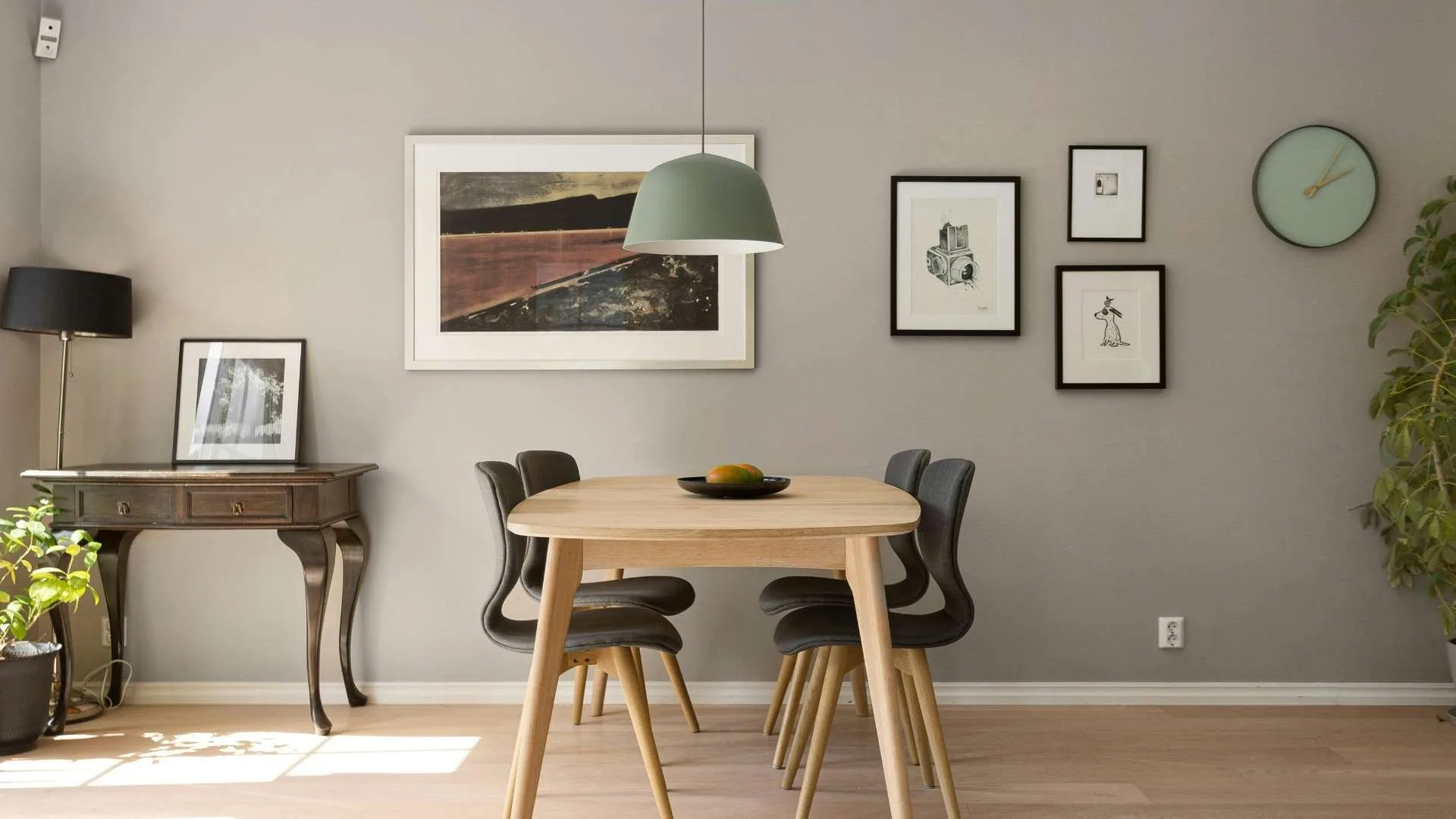
Gallery walls get a bad reputation — and often for good reason. Done poorly, they look chaotic, random, and exhausting to look at. But done with care, a gallery wall is one of the most expressive and personal things you can put in a home.
The key is having a unifying principle. It doesn’t need to be rigid, but there should be something that holds the collection together. It might be a consistent frame colour or material. It could be a limited palette running through the images themselves. Or it might simply be a single subject or theme — botanical prints, black and white photography, travel sketches.
Lay everything out on the floor first. Photograph it. Adjust the arrangement until the spacing feels even and the overall shape of the group is pleasing — usually a loose rectangle or horizontal band works well. Only then start putting holes in the wall.
Paint by number kits: a surprising and personal option
This one surprises people, but it works. Paint by number kits have come a long way from the hobby-store sets of decades past. Today’s versions — particularly custom ones made from your own photographs — produce finished pieces that are genuinely beautiful and, perhaps more importantly, entirely unique. If you’ve been curious about the process or what the final results look like, you can see the full details on how custom kits are put together and the quality you can expect from a finished piece.
The result is a large-format painting made by your own hand, of a subject that actually means something to you — a family portrait, a favourite landscape, a pet, a place. No art degree required, and no two pieces are ever the same. Beyond the finished product, the process itself has value. Painting by number is meditative. It takes time, but it’s time well spent — and when you hang the result, you know exactly what went into it. That changes how a piece feels in a space. It’s not just decoration; it’s something you made.
Practically speaking, the finished canvases are already primed and ready to hang. They come in sizes that work well as statement pieces, and because they’re painted on canvas, they have the visual weight and texture of traditional art. They look right at home in a living room, bedroom, or hallway — and they tend to prompt a lot of conversation.
Shelving, plants, and objects as wall treatments
Not everything has to be flat. Floating shelves bring dimension to walls and allow you to layer objects — books, small plants, ceramics, candles — in a way that evolves over time. The wall itself becomes a surface for living rather than just a background.
Trailing plants mounted in wall brackets are another underused option. A pothos or heartleaf philodendron grows quickly, looks lush, and costs almost nothing. A few mounted planters along a bare wall can transform a room from sterile to genuinely warm in a matter of weeks.
Objects don’t have to be expensive to look considered. A few pieces of driftwood, a collection of hats, or a grid of small mirrors can be just as effective as a curated art collection — sometimes more so, because they reflect the personality of the person who lives there. As the Design Council notes, the most effective design decisions are those that are driven by genuine human need and context, rather than trend-following.
Lighting as the final layer
Whatever you put on your walls, lighting will determine whether it looks good or not. Natural light during the day is a given, but evening lighting is often neglected. A piece of art in a poorly lit room loses half its impact. A bare wall with a well-placed picture light or uplighter can look more interesting than a crowded wall in bad lighting.
Wall-mounted sconces, clip-on picture lights, and directional floor lamps that wash light up a wall are all worth considering. They add warmth, draw attention to what matters, and create a completely different atmosphere than ceiling lighting alone. Think of light as the final layer of any wall treatment — not an afterthought.
Putting it all together
Making blank walls feel intentional isn’t about filling every inch of space or following design trends. It’s about making deliberate choices that reflect how you live and what you value. Sometimes that means a single large piece of art. Sometimes it’s a painted texture or a row of floating shelves. Sometimes it’s a canvas you painted yourself from a photograph that means something.
The common thread in every approach that works is intention. Something chosen, placed, and considered — rather than grabbed and stuck up. Once you start looking at your walls as opportunities rather than problems, the solutions tend to present themselves more clearly than you’d expect.
Start with one wall. Do it properly. See how it changes the feel of the room. Then move on to the next.