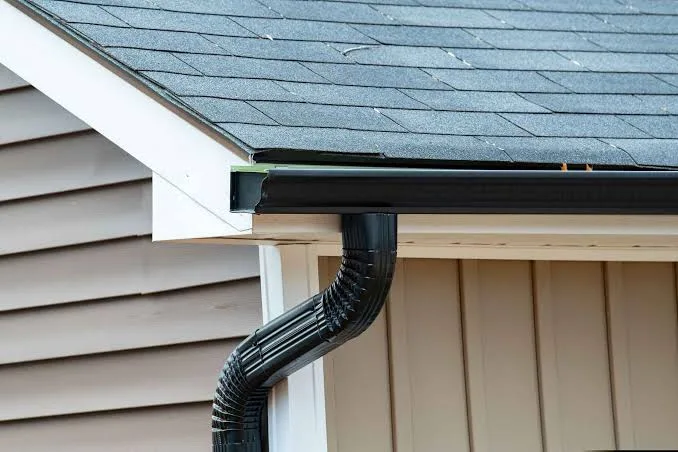
Watch a house during a steady rain and you can see how quickly roof water becomes a ground level drainage problem. Gutters collect runoff across the roof and direct it toward a relatively small number of downspouts. At the bottom of each one, all that water has to go somewhere.
A downspout that empties beside the foundation may leave a puddle after every storm. On another property, the water cuts through mulch before reaching the lawn. It may cross a walkway, collect behind a retaining wall, or disappear into an underground pipe whose outlet nobody remembers.
The easiest way to understand whether the setup works is to follow the water. Start where it leaves the downspout and keep going until you know where it finally discharges or soaks into the ground. If you cannot trace that route, there is a part of the drainage system you do not yet understand.
Start at the Bottom of the Downspout
A downspout concentrates water collected from a much larger roof surface into one discharge point. That is why a relatively small area beside the house can receive a substantial amount of water during a storm.
Go outside during a moderate rain and watch the bottom of the downspout. Water should leave without immediately creating another problem.
Look for soil washing away, mulch moving across a bed, water collecting against the foundation, or runoff crossing a walkway. Check whether an extension has shifted or whether water is spilling from a connection instead of continuing through it.
Then look several feet away. A downspout can appear to be draining properly while the water simply moves into a nearby low spot and sits there.
The wall and foundation deserve attention as well. Repeated splashing can stain lower exterior surfaces, while concentrated runoff close to the building can keep the surrounding ground wetter than intended. Homes with basements or crawl spaces have an obvious reason to keep surface runoff moving away from the foundation.
Do not judge the setup only when the yard is dry. The useful information appears when water is actually moving.
Read the Yard Before Buying Drainage Parts
Before extending a downspout or digging a trench, look at where the water could realistically go.
Walk away from the house and pay attention to grade. Does the ground continue downhill? Does a patio or walkway interrupt the route? Is there a low part of the lawn that already remains wet? Are neighboring properties close enough that moving water farther from your foundation could simply send it next door?
Hardscape can change the picture considerably. A driveway or patio collects its own runoff, while retaining walls and raised planting beds can interrupt the natural path water once followed.
Use the existing landscape as evidence.
| What You See | What to Think About |
| Ground clearly falls away from the house | A visible surface route may be possible |
| Downspout empties inside an enclosed planting bed | Check whether the bed has somewhere to release excess water |
| A walkway blocks the downhill route | Consider whether the water needs to cross beneath it or take another route |
| A low lawn area already stays wet | Avoid assuming it can accept additional roof runoff |
| A patio or driveway slopes toward the house | Roof water may join other runoff already moving toward the foundation |
| The property line is close and downhill | Make sure the proposed discharge does not create a problem next door |
| A basement wall is close to the discharge point | Pay particular attention to where concentrated runoff goes |
These observations will not design the drainage system for you, but they can eliminate some poor choices before any work begins.
A low spot, for example, is not automatically a good outlet simply because gravity carries water there. If it remains saturated long after storms, adding roof runoff may make an existing problem worse.
Keep the Water Visible or Take It Underground?
If the yard has a clear downhill route and enough open space, keeping roof runoff above ground may be the simplest option. Downspout extensions, appropriate grading, and suitable landscape drainage routes allow you to see where the water travels and notice quickly when something changes.
Surface routing is worth considering when the water can move away from the foundation without crossing an important walking area, damaging landscaping, causing erosion, or affecting neighboring property.
It also makes maintenance straightforward. If an extension gets kicked out of position or leaves begin blocking the route, the problem is visible.
A buried line may make more sense when a walkway, landscaped area, or another feature interrupts an otherwise suitable drainage path. It can also keep a long extension from lying across an area used for mowing, walking, or outdoor living.
For example, imagine a front downspout beside the main walkway. Leaving several feet of exposed pipe across the path would be inconvenient and could create a trip hazard. Removing the extension altogether would put the discharge back beside the house. If site conditions allow it, a properly planned underground crossing can preserve the walkway while continuing the drainage route.
Burying a pipe, however, does not solve a destination problem. Before digging, you should already know where the line will start, where it will end, whether the route can drain toward that outlet, and how the system could be reached if it eventually needs cleaning or repair.
If you cannot identify a suitable outlet first, the underground plan is not finished.
Making the Transition From Downspout to Drain Pipe
Rectangular downspouts and round drainage pipe do not connect directly without an appropriate transition.
When runoff is being directed into a compatible nonpressurized underground drainage line, downspout adapters can make that connection. NDS Pro offers adapters for common rectangular downspout sizes and different compatible drain pipe systems.
Matching only the downspout opening is not enough. Check both ends of the connection. The adapter has to fit the downspout size as well as the type and size of the drainage pipe receiving the water. NDS, for example, offers different configurations for corrugated drain pipe, sewer and drain pipe, and DWV or Schedule 40 connections.
The adapter is only the entrance to the buried system. A neat connection beside the house cannot compensate for a crushed pipe, poor route, clogged line, or unsuitable outlet farther away.
Think about debris too. Leaves, seeds, roofing material, and other material that reaches the gutter can travel toward the downspout. Keeping gutters clear reduces the amount of debris entering whatever drainage system follows.
Plan the Buried Route Before Opening the Ground
A gravity drainage line needs to keep carrying water toward its outlet. Changes in elevation along the route matter, as do the condition of the pipe and the way it is supported.
A section that settles can create a low area where water and sediment collect. A crushed pipe can restrict flow. Connections can shift if they are poorly supported. Roots or accumulated debris may create problems later.
Before excavation, be able to answer four basic questions:
- Where does the buried line begin?
- Where exactly will it discharge?
- Can the route continue draining toward that point?
- How could the line be inspected or cleared if it becomes clogged?
The last question is easy to overlook when everything is new. Once a drain line is buried beneath finished landscaping, access becomes much less convenient. Drainage manufacturers, including NDS, make cleanout components specifically to provide access for clearing compatible drainage piping. Whether and where access is appropriate depends on the design, but maintenance should at least be considered before the pipe disappears underground.
Avoid prescribing a pipe size or slope based only on what another homeowner used. Roof area, local rainfall, the number of downspouts feeding the system, pipe material, route length, fittings, grade, and outlet conditions can all affect the design.
A line carrying one small roof section has a different job from a system receiving several downspouts.
Take photos before backfilling a new installation. Include nearby permanent features so the pipe route can be located later. Those photos become surprisingly valuable after landscaping changes hide every sign of the trench.
Do Not Send Roof Water Into an Existing Problem
One of the easiest drainage mistakes is moving water away from the house without thinking carefully about what happens at the other end.
A low corner of the yard may seem convenient because water already travels there. If that area remains wet for days after ordinary rain, adding concentrated roof runoff could enlarge the saturated area or keep it wet longer.
The same caution applies to a spot where water can turn and flow back toward the house.
Be wary of proposed outlets that place runoff beside the foundation, across frequently used pavement, onto a bare slope vulnerable to erosion, or toward neighboring property. An underground pipe of unknown purpose is another poor candidate.
Older properties sometimes contain buried piping that nobody can immediately identify. Do not connect roof runoff simply because a pipe happens to be nearby. Find out what it serves and where it goes.
Moving water out of sight is not the same as managing it.
Choose the Outlet With the Whole Property in Mind
Depending on the site and local requirements, roof runoff may eventually discharge across a suitable landscape area, enter a properly designed rain garden or other infiltration feature, reach an approved storm drainage connection, or use another lawful drainage method.
The appropriate choice depends on conditions at the property.
A rain garden, for example, is not simply a decorative depression where a downspout can be directed. Its location and size need to account for the amount of runoff entering it, the soil’s ability to accept water, groundwater conditions, nearby structures, and other site constraints.
The same principle applies to other infiltration approaches. Ground that already drains poorly or has unsuitable groundwater conditions may not perform the way a homeowner expects.
Local requirements also matter. Communities can regulate stormwater connections, discharge locations, work near sidewalks or rights of way, and other parts of residential drainage.
Do not assume that roof runoff can be connected to a sanitary sewer because a sewer pipe is available underground. Many communities prohibit stormwater from entering sanitary sewer systems because those systems are intended to carry wastewater. If an existing underground connection is unclear, check with the appropriate local authority before using it.
The outlet should be identified with as much care as the connection beside the house.
Know When the Property Needs More Than a Simple DIY Fix
Some homes have an obvious solution: the ground slopes away, there is plenty of open landscape, and the runoff can reach a suitable area without crossing anything important.
Other properties are much harder.
Professional drainage evaluation becomes worth considering when there is no clear downhill outlet, several downspouts need to feed one system, or significant grading would be required. Recurring basement moisture, existing standing water, retaining walls, high groundwater, difficult soil conditions, and complicated hardscape can also make the site harder to evaluate from the surface.
Neighboring property is another reason for caution. A drainage project should not solve one homeowner’s wet yard by creating runoff problems next door.
Be particularly careful when the only apparent solution depends on connecting to an underground sewer or storm drain whose use has not been confirmed.
A professional looking at the entire property can consider elevations, runoff routes, soil conditions, existing drainage infrastructure, and the relationship between several problem areas. That can be more useful than treating each downspout as an isolated project.
Watch the System During Real Rain
A dry weather inspection tells you where the components are. Rain tells you whether they work together.
During a substantial but safe rainfall, follow one downspout from the roof toward its outlet.
At the house, check whether the gutter is overflowing and whether the downspout is carrying water freely. Look for leaks at connections and water collecting close to the foundation.
Continue along the drainage route. If the water remains above ground, notice whether it erodes soil, crosses pavement, or stalls in a low area. If the line goes underground, look farther along the route for unexpected wet patches or water surfacing before it reaches the outlet.
Then find the end.
Water should be able to leave without immediately creating another problem. An outlet buried beneath mulch, covered by vegetation, submerged in standing water, or pointed toward an unsuitable area deserves attention even if everything upstream looks perfect.
Stay outside long enough to see what happens after several minutes of rainfall. Some low areas and restrictions are not obvious the moment water begins flowing.
Fit the Drainage Into the Landscape Without Hiding It Completely
Residential drainage has to coexist with the way people actually use the property.
Long exposed extensions can interfere with mowing and walking. Underground lines can preserve open areas and reduce visual clutter where the site supports them. Planting and grading can sometimes help integrate surface drainage into the landscape rather than treating it as an afterthought.
The system still needs to remain understandable.
Avoid burying an outlet beneath dense planting or covering an important access point with permanent hardscape. If a component may eventually need inspection or cleaning, plan for someone to reach it without dismantling part of the yard.
Landscape projects can also change drainage that worked perfectly well before construction. A new patio may interrupt a surface route. A raised bed can create a barrier. Additional soil can change grade around the foundation. Mulch can cover an outlet. Mature plants can make a previously visible discharge point difficult to find.
Before changing the landscape around a downspout or drainage route, look at where rainwater currently travels. Preserving that path may be easier than trying to recreate it after the project is finished.
Recheck the Route When Something Around It Changes
Drainage maintenance does not need to become a complicated schedule. Three situations are especially useful reminders to look at the system again.
After major storms, check for erosion, pooling, displaced extensions, exposed pipe, and outlets blocked by debris.
After landscaping or construction, make sure new soil, mulch, plants, patios, edging, or other work has not altered the drainage path or buried something that needs to remain accessible.
Seasonally, clean gutters as needed and confirm that downspouts, underground entrances, visible connections, and outlets remain open.
If a drainage route suddenly stops performing the way it used to, think about what changed around it. The cause may be as simple as an extension moved during mowing or as significant as settlement along a buried line.
Follow One Downspout During the Next Good Rain
The next time there is a steady rain, choose one downspout and follow the water.
See where it leaves the house and whether the ground carries it away. If it enters an underground line, find the outlet. Watch what happens there rather than assuming the water disappears successfully because the pipe is buried.
If the water collects somewhere along the route, look at what is stopping it. If it washes soil away, consider how concentrated the discharge has become. If it turns and comes back toward the house, the route needs attention.
Once you can trace the water from the roof to its final destination, decisions about extensions, buried drainage, landscaping, and outlets become much easier to make.