Your pool deck or patio has faded, the old coating is flaking, and the surface feels rough after years of Florida sun. Resurfacing can refresh worn concrete without tearing it out, as long as the slab can support the new finish.
For Port Orange homeowners, four things shape the decision: the type of concrete coating, whether stone or resin resurfacing suits the space, how slip-resistant the finished surface will be, and how well it holds up to UV exposure.
Start With the Slab
Every resurfacing system depends on the concrete underneath it. Sika’s August 2025 data sheet for Sikalastic-658, a coating made for uses including swimming pool decks, requires concrete that is structurally sound, fully cured, clean, and dry. A professional installer should inspect the existing surface before recommending any system.
Walk your patio or pool deck and note peeling or bubbling coatings, uneven sections, cracks that returned after a patch, and puddles that linger after rain. Photos alone cannot show whether the slab is moving, so have these conditions assessed in person. A new finish cannot correct an underlying structural problem.
Concrete Coatings
A concrete coating adds a protective layer of color and, depending on the system, texture. It is often the most direct way to refresh a patio or pool deck that is structurally sound but worn on the surface.
When comparing coatings, ask for the specific outdoor product, the required coat count, and the care instructions. Coat count matters: BEHR PREMIUM Granite Grip, a textured coating for surfaces such as patios and pool decks, requires two coats for optimal durability and coverage. Skipping a coat to save time or money can shorten the life of the finish.
Ask the installer how the coating handles pool chemicals, foot traffic, and moisture, and request the product data sheet so you can compare systems on the same terms.
Stone and Resin Resurfacing
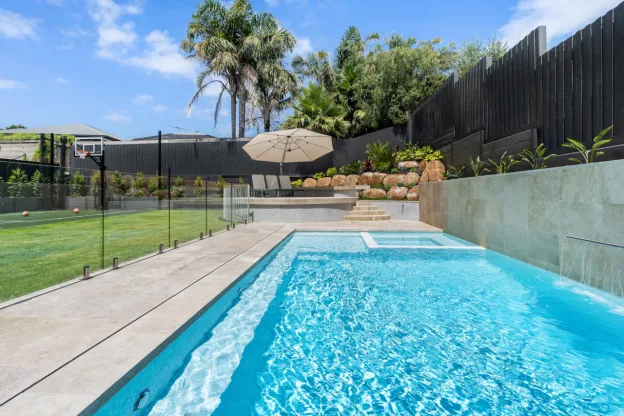
Stone-resin resurfacing bonds decorative natural aggregate with a resin binder to create a seamless, textured surface for pool decks, patios, and walkways. The finish suits homeowners who want a natural-stone look without grout lines.
For homeowners comparing pool deck resurfacing options in Port Orange, Raz-Barry Coatings offers UV-stable resin resurfacing for pool decks, built for Florida weather, along with a quartz coating system that adds UV stability and an anti-slip texture for outdoor use.
Before choosing a stone or resin system, ask how the installation will handle water from the surface to the edge. Do not assume the finished surface drains through itself.
Slip Resistance
A pool deck or patio that gets wet needs reliable traction. Slip resistance comes from the finished texture of the system, not the material name, so compare samples rather than product labels.
Several approaches add grip. Some coatings are made slip-resistant from the start: Sikalastic-658 is a water-based, slip-resistant acrylic coating for pedestrian surfaces. Others rely on additives; Sherwin-Williams’ H&C SharkGrip, for example, is mixed into coatings to improve slip resistance on concrete. Textured overlays offer another route, such as a knockdown finish, where an acrylic texture is sprayed on and then flattened into a textured surface.
Drainage affects traction too. Sika notes that Sikalastic-658 is not recommended on surfaces subject to water ponding and advises sloping surfaces to drain. Ask how the proposed system and the deck’s slope will keep water from standing.
UV-Resistant Coatings
Florida sun fades and weakens finishes that are not built for it. UV-resistant coatings help a pool deck or patio keep its color longer. Sherwin-Williams says the UV-resistant shield in its H&C Cool Feel coating, made for pool decks, patios, and lanais, helps reduce fading. Sika lists excellent UV resistance among the characteristics of Sikalastic-658.
UV resistance protects color, but it does not determine how hot a surface feels underfoot. Lawrence Berkeley National Laboratory’s Heat Island Group explains that solar-reflective pavements stay cooler in sunlight than traditional pavements. If barefoot comfort matters, ask for product-specific evidence on surface temperature rather than relying on a UV claim alone.
Compare Quotes for the Same Work
Two bids for the same patio or pool deck can describe different jobs. Compare their scope before looking at the totals.
A useful proposal lists the measured area, removal of existing coatings, surface preparation, crack repairs, the named coating or resin system, and the final texture. It should also explain any planned moisture or drainage work. Request a written proposal that confirms the finish, preparation, and aftercare rather than assuming a standard installed price.
Ask separately about walking on the surface, moving furniture back, and the first water exposure. Sika warns that cooler temperatures or high humidity greatly extend drying times for Sikalastic-658, so the return-to-use schedule should account for the product and the weather. Request written cleaning instructions and warranty exclusions; BEHR’s Granite Grip instructions, for example, call for mild detergent as needed. Once the new surface has cured, these outdoor living space ideas can help you plan how to furnish and use the area.
Conclusion
A sound slab is the starting point. From there, compare the concrete coating or stone-resin system, the finished slip resistance, and the UV resistance of each option. Port Orange homeowners who weigh all four before hiring a contractor are more likely to end up with a patio or pool deck that looks good and stays safe to walk on.
FAQs
Can a cracked patio or pool deck be resurfaced?
Sometimes. The cause of the cracking and whether the slab is still moving determine what repair is needed. Have the concrete assessed before accepting a proposal to cover it.
Which finish is least slippery when wet?
The material name alone cannot answer that. Compare the finished texture and any slip-resistant additives, and ask what wet-traction information is available for the proposed system.
Does a UV-resistant coating keep the deck cool?
Not necessarily. UV resistance helps protect color, while surface temperature depends more on solar reflectance. Ask for product-specific temperature evidence if comfort matters.
When can I put furniture back?
Follow the written schedule for the installed system. Cooler temperatures or high humidity can extend drying times.