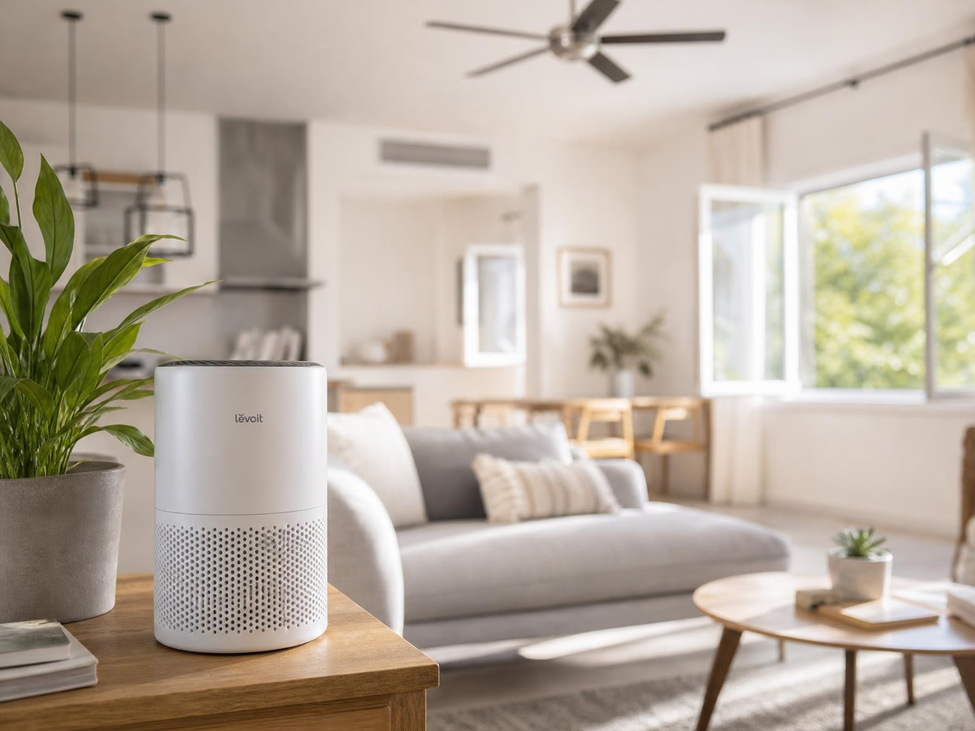
Most of us spend the bulk of our lives indoors—at home, at work, in school—and that’s precisely where pollutants tend to build up. Cooking, cleaning, off-gassing furniture and building materials, dust, pet dander, even secondhand smoke all contribute to the mix. Without enough fresh air moving through a space, these contaminants simply accumulate instead of dissipating. A portable air purifier is one tool some households turn to for capturing airborne particles, but it only addresses one piece of a much larger puzzle. Indoor air quality is really a home-health and comfort issue shaped by several factors working in tandem—not something a single device can solve on its own.
This article walks through how to spot common indoor pollutants, cut them off at the source, improve ventilation, and use filtration where it actually makes sense—as a complement to those efforts, not a substitute for them.
Key takeaway: Cleaner indoor air usually comes from a combination of source control, ventilation, and filtration working together, not from leaning on any one solution.
Understanding Common Indoor Air Pollutants
Particles and allergens cover dust, pet dander, pollen, mold spores, and smoke particles. Some are large enough to watch settle onto surfaces, while others stay suspended in the air for hours at a time. It’s usually these smaller, harder-to-see particles that matter most for people with asthma or allergies, since they can travel deeper into the lungs when inhaled.
Gases and chemical pollutants play by different rules than particles do. Volatile organic compounds—often released from paints, solvents, fragrances, and new furnishings—linger in the air as vapors rather than settling out like dust. Carbon monoxide is a separate and far more dangerous concern: it’s an odorless gas tied to fuel-burning appliances that can be fatal if a home doesn’t have a working detector. Since particle filters aren’t built to capture gases, it helps to remember that different pollutants call for different control methods.
Moisture and biological growth typically trace back to leaks, poor drainage, or condensation. Persistent dampness invites mold, and getting ahead of moisture problems is far more effective than scrambling to clean up after mold has already taken hold. For extensive or recurring mold issues, a qualified professional is generally a better bet than trying to handle it through air treatment alone.
Start With Source Control
The most direct way to improve indoor air is to cut pollutants off at the source. That might mean using cleaning and maintenance products as directed on the label, choosing lower-emission materials during a renovation, keeping fuel-burning appliances properly serviced, skipping indoor smoking altogether, and fixing leaks as soon as they’re noticed. Cutting down on clutter and dust-trapping fabrics in high-traffic rooms helps too.
Picture two households dealing with strong cooking odors. One reaches for an air freshener, masking the smell while adding its own airborne compounds to the mix. The other switches on an exhaust fan that vents outdoors, physically clearing out the smoke, grease particles, and moisture at the source. The second approach actually solves the problem instead of just covering it up. It’s also worth keeping in mind that labels like “natural” or “green” don’t guarantee a product is free of airborne irritants.
Improve Ventilation Safely
Ventilation works by swapping in or diluting indoor air with air from outside, which lowers the overall concentration of pollutants. In practice, that can mean opening windows when the weather and outdoor air quality cooperate, running kitchen and bathroom exhaust fans that actually vent outside rather than recirculate indoors, and keeping mechanical ventilation systems properly maintained. During wildfire smoke events or spells of heavy outdoor pollution, though, it’s smarter to limit how much outdoor air comes in.
Kitchen ventilation deserves special attention, since cooking is one of the most reliable sources of indoor particles and gases in any home. It’s worth double-checking whether a range hood actually pushes air outdoors or just filters and recirculates it back into the room—not every unit does the same job. Ventilation needs also shift depending on building layout, climate, and HVAC design, so what works well in one home might need tweaking in another. The U.S. Environmental Protection Agency frames source control, ventilation, and air cleaning as complementary strategies meant to work together, not in isolation.
Use Filtration as a Supplement
Filtration—whether through a portable unit or a central HVAC system—can help cut down airborne particles within its operating limits. A portable device typically only treats the room it’s sitting in, while an HVAC filter works across the airflow capacity of the entire system. Two things determine how well filtration actually performs: how efficiently the filter captures particles, and how much air passes through it in the first place. A high-efficiency filter crammed into a system that can’t handle the added resistance may end up reducing airflow instead of improving air quality.
The EPA generally recommends picking the highest-rated filter a system can safely handle, often pointing to MERV 13 as a useful benchmark where it’s compatible. But filtration doesn’t catch everything—gases and certain chemical vapors slip right through many standard particle filters—so it’s best treated as a supplement to source control and ventilation, not a stand-in for either. Before buying any filtration equipment, check the manufacturer’s instructions, recommended room size, filter replacement schedule, noise level, and ongoing running costs.
Match the Response to the Problem
Different pollutants call for different responses:
- Cooking particles or odors: Use an outdoor-vented range hood and adjust cooking practices.
- Dust and allergens: Clean surfaces and bedding regularly and address entry points.
- Mold concerns: Resolve moisture intrusion before focusing on airborne spores.
- Chemical odors: Remove or isolate the source and ventilate thoroughly.
- Carbon monoxide risk: Install working alarms and service fuel-burning appliances.
- Outdoor smoke: Keep windows closed during hazardous periods and rely on suitable filtration if available.
Persistent symptoms like headaches or trouble breathing shouldn’t automatically be pinned on indoor air quality—a healthcare professional can help figure out what’s actually going on, while a building or HVAC specialist can look into structural or ventilation issues.
Maintenance Practices That Support Cleaner Air
Make a habit of inspecting HVAC filters, exhaust fans, range hoods, humidifiers, dehumidifiers, and any other air-cleaning equipment in use. Sticking to manufacturer maintenance schedules matters, since neglected filters or damp components don’t just lose effectiveness—they can introduce their own hygiene problems. A simple maintenance calendar, noting filter changes and appliance servicing, can help renters and homeowners alike catch recurring issues early instead of after they’ve snowballed. And when cleaning, skip dry sweeping heavily contaminated areas—it tends to scatter dust around rather than actually remove it.
How to Evaluate Indoor-Air Advice
Not all indoor-air claims hold up equally well. Look for transparent testing methods, clearly defined pollutant types, realistic room-size assumptions, and guidance backed by independent or government sources. Treat absolute claims like “removes all toxins” or “eliminates allergies” with a healthy dose of skepticism, and remember that less odor doesn’t necessarily mean fewer harmful pollutants. The EPA and public-health or building-science professionals remain solid references, particularly on the point that filtration supplements source control and ventilation—it doesn’t replace them.
Practical Indoor-Air Improvement Plan
A simple sequence can guide most situations: identify the likely pollutant or source, reduce or repair it, ventilate with outdoor air when conditions allow, check humidity and moisture levels, maintain HVAC and exhaust systems, add compatible filtration only where it fits the specific problem, and verify results rather than assuming one improvement—like less odor—means the issue is fully resolved. When risks or symptoms persist, don’t hesitate to seek professional or medical advice.
A More Reliable Way to Think About Healthier Indoor Air
Improving indoor air isn’t a one-time purchase or a weekend cleaning task—it’s an ongoing process. The general hierarchy still holds up: control pollution at the source, ventilate with clean outdoor air when it makes sense, keep building systems well maintained, and use filtration as a targeted supplement rather than a cure-all. The right combination depends on the pollutant, the building, the people living in it, and the equipment on hand. As a starting point, pick one likely pollution source to investigate, one ventilation or maintenance step to improve, and one simple way to check whether things actually get better.