We often think of air pollution as an outdoor problem, but the truth is, the air we breathe inside our homes, schools, and workplaces can be far more contaminated. With people spending between 60% and 90% of their time indoors, the quality of this air directly impacts our health and productivity. Alarmingly, indoor air pollution can be 2 to 12 times higher than outdoor levels, contributing to an estimated 3.2 million premature deaths globally each year by July 2026. This issue is particularly pronounced in energy-efficient buildings that, while great for energy savings, can inadvertently trap pollutants without proper ventilation.
Understanding and actively improving indoor air quality (IAQ) is not just a preference; it’s a critical component of a healthy lifestyle and productive environment. In this extensive guide, we will explore the hidden threats lurking in our indoor spaces, from common pollutants like VOCs and particulate matter to the significant health risks they pose, both short-term and long-term.
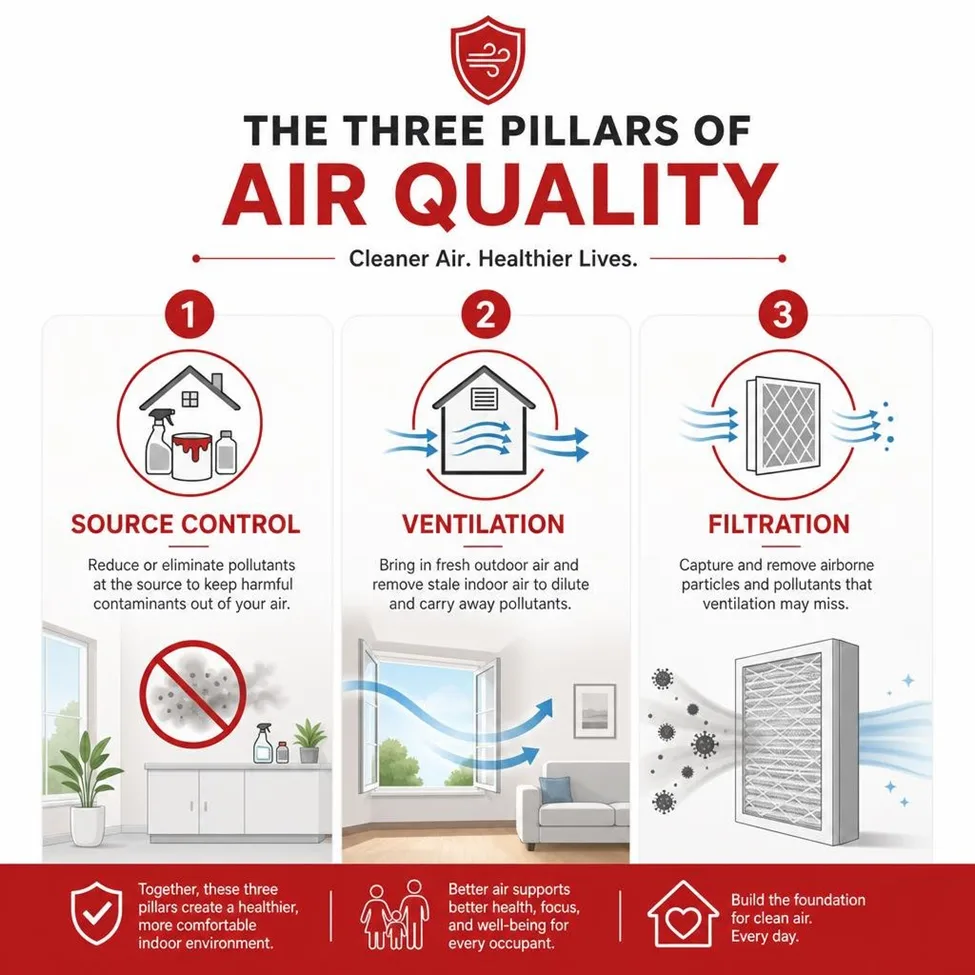
We will then dive into the most effective strategies for improving indoor air quality, focusing on source control, optimized ventilation, and advanced air filtration. Ensuring your indoor environment is healthy often requires a blend of these approaches, and for many, consulting with an Expert indoor air quality professional can provide tailored solutions. Join us as we uncover how modern HVAC systems and smart practices are essential allies in transforming your indoor spaces into havens of fresh, clean air.

The air within our buildings is a complex mixture, constantly influenced by a myriad of sources. These sources can be found everywhere, from the materials used in construction to the products we use daily, and even in our own activities. Identifying these pollutants is the first step toward mitigating their impact on our health and well-being.
Common Pollutants and Their Health Impacts
Volatile Organic Compounds (VOCs) are gases emitted from certain solids or liquids. Indoors, common sources include paints, varnishes, wax, cleaning supplies, disinfectants, air fresheners, building materials, and new furnishings. Short-term exposure can cause eye, nose, and throat irritation, headaches, and nausea. Long-term exposure to some VOCs is linked to kidney damage, liver damage, and central nervous system damage, and some are suspected carcinogens.
Particulate Matter (PM), including PM2.5 (fine particles) and PM10 (coarse particles), consists of tiny solid or liquid droplets suspended in the air. Sources include cooking (especially frying and grilling), burning candles or incense, fireplaces, tobacco smoke, and outdoor pollution infiltrating indoors. These microscopic particles can penetrate deep into the lungs and even enter the bloodstream. Exposure is linked to respiratory issues like asthma and bronchitis, cardiovascular problems, and even premature death.
Carbon Monoxide (CO) is a colorless, odorless gas often called the “silent killer.” It’s produced by incomplete combustion in appliances such as furnaces, water heaters, stoves, and fireplaces, especially when they are poorly maintained or vented improperly. CO poisoning can lead to headaches, dizziness, nausea, confusion, and in severe cases, unconsciousness and death.
Radon is a naturally occurring radioactive gas that seeps into buildings from the soil. It is the leading cause of lung cancer among non-smokers and the second leading cause overall, responsible for 3–14% of cases in many countries, leading to tens of thousands of deaths annually. Because it is undetectable without specialized testing, it often goes unnoticed.
Mold thrives in damp environments and releases spores, which can trigger allergic reactions, asthma attacks, and other respiratory problems. Common sources include water leaks, high humidity, and poor ventilation in bathrooms, kitchens, and basements.
Beyond these, building materials themselves can be significant contributors. Formaldehyde, a common VOC, is found in pressed-wood products, glues, and insulation. Historically, asbestos in older buildings poses a risk when disturbed. Even modern materials and textiles can shed microplastics, whose long-term health effects are still being researched. Consumer products, from cleaning agents to personal care items, frequently release VOCs and other chemicals that can react in the air to form secondary pollutants.
The health risks associated with poor IAQ range from immediate discomfort to severe, chronic conditions. Short-term effects often include irritation of the eyes, nose, and throat, headaches, dizziness, fatigue, and difficulty concentrating. These symptoms are often associated with Sick Building Syndrome (SBS), in which occupants experience acute health and comfort effects that appear to be linked to time spent in a building. Still, no specific illness or cause can be identified.
Long-term exposure to indoor pollutants can lead to more serious consequences, including the development or exacerbation of respiratory diseases such as asthma, chronic obstructive pulmonary disease (COPD), and allergies. Particulate matter and other pollutants have been linked to cardiovascular disease. Elevated levels of CO2 and certain VOCs can impair cognitive function, reducing productivity and learning outcomes. And, as mentioned, radon is a direct cause of lung cancer.
Here’s a simplified overview of common indoor pollutants:
Pollutant Type Common Sources Primary Health Risks VOCs Paints, cleaners, furniture, building materials Irritation, headaches, liver/kidney damage, some are carcinogenic Particulate Matter Cooking, smoke, dust, combustion, outdoor infiltration Respiratory issues (asthma, bronchitis), cardiovascular disease, lung damage Carbon Monoxide Faulty combustion appliances (furnaces, stoves) Headaches, dizziness, nausea, unconsciousness, death Radon Soil, well water, building materials Lung cancer (leading cause among non-smokers) Mold Water damage, high humidity Allergies, asthma attacks, respiratory infections, irritation Formaldehyde Pressed wood, glues, insulation Eye/nose/throat irritation, asthma, potential carcinogen Asbestos Older building materials (insulation, tiles) Mesothelioma, lung cancer, asbestosis (when fibers are disturbed) Microplastics Textiles, furniture, consumer products Emerging concerns, potential for inflammation and respiratory issues Environmental Disparities in Developed and Developing Nation.s
The challenges of indoor air quality are not uniform worldwide. We observe significant environmental disparities between developed and developing nations.
In developing countries, a primary driver of indoor air pollution is the widespread reliance on biomass fuels (wood, animal dung, crop waste) and traditional cookstoves for cooking and heating. Over 3 billion people, particularly in the Southern Hemisphere, still use these methods, resulting in extremely high levels of indoor particulate matter and other harmful pollutants. The World Health Organization (WHO) estimates that cooking-related indoor air pollution causes a staggering 3.8 million annual deaths globally, with a disproportionate impact on women and young children who spend more time near these sources. In sub-Saharan Africa, for instance, 80% of the population is exposed to traditional stoves.
Conversely, in developed countries, while traditional biomass burning is less prevalent, the IAQ landscape is dominated by other concerns. Modern, airtight building envelopes designed for energy efficiency can inadvertently trap pollutants from a wide range of synthetic chemicals used in building materials, furnishings, and consumer products. VOCs from new furniture or cleaning products, formaldehyde from pressed wood, and pesticides are common culprits. The focus here shifts to managing emissions from a wider array of manufactured goods and ensuring adequate mechanical ventilation to dilute these contaminants.
Regional variations also play a role. For example, in mining regions like Chile, dust and emissions from extraction sites can affect both company offices and nearby communities, underscoring how industrial activities can contribute to localized indoor air pollution. Addressing these disparities requires tailored solutions, ranging from clean energy transitions in developing nations to advanced ventilation and source-control strategies in developed nations.
The Critical Role of Ventilation in Maintaining Indoor Air Quality
Ventilation is the process of replacing indoor air with outdoor air, and it’s absolutely fundamental to maintaining good indoor air quality. Without adequate ventilation, pollutants accumulate, leading to higher concentrations and greater health risks.
There are several ways buildings achieve ventilation:
- Natural ventilation relies on passive forces, such as wind pressure and thermal buoyancy (the stack effect), to move air through openings such as windows, doors, and vents. While cost-effective, it’s often uncontrolled and weather-dependent, making it unreliable for consistent IAQ.
- Mechanical ventilation uses fans tofans to bring in outdoor air and actively exhaust indoor air. This can be part of a central Heating, Ventilation, and Air Conditioning (HVAC) system or dedicated exhaust fans in bathrooms and kitchens. Mechanical systems offer more control over airflow rates and filtration.
- Infiltration is the uncontrolled leakage of outdoor air into a building through cracks, gaps, and other unintentional openings in the building envelope. While it contributes to air exchange, it’s inefficient and doesn’t allow for filtration or conditioning of the incoming air.
The goal is to achieve sufficient outdoor air exchange to dilute and remove indoor pollutants. Organizations like ASHRAE (American Society of Heating, Refrigerating, and Air-Conditioning Engineers) set minimum ventilation standards. ASHRAE Standard 62.1 provides requirements for acceptable indoor air quality in commercial and institutional buildings, while ASHRAE Standard 62.2 focuses on residential buildings. These standards are crucial benchmarks for designers and operators to ensure healthy indoor environments.
However, increasing ventilation also directly impacts energy consumption. Bringing in and conditioning more outdoor air (heating it in winter, cooling it in summer) requires more energy. This creates a balancing act, especially in the context of climate change and the drive for more energy-efficient buildings. While highly insulated and airtight buildings reduce energy loss, they can also inadvertently trap pollutants if not paired with effective mechanical ventilation systems. This highlights the need for integrated design approaches that prioritize both energy efficiency and IAQ.
Mechanical Ventilation and Energy-Efficient Building Designs
Modern HVAC systems offer sophisticated solutions to balance ventilation needs with energy efficiency. Heat Recovery Ventilators (HRVs) and Energy Recovery Ventilators (ERVs) are prime examples. These systems continuously exhaust stale indoor air and supply fresh outdoor air while recovering a significant portion of the energy used to heat or cool the indoor air. HRVs transfer heat, while ERVs transfer both heat and moisture, making them ideal for different climates. They are particularly valuable in net-zero homes and other highly energy-efficient buildings, where uncontrolled infiltration is minimized, and controlled mechanical ventilation becomes essential to prevent pollutant buildup.
When discussing HVAC systems, SEER ratings (Seasonal Energy Efficiency Ratio) are often used to measure cooling efficiency. While primarily an energy metric, an efficiently operating system is often better maintained and integrated, contributing indirectly to better IAQ through consistent air circulation and filtration.
Crucially, modern HVAC systems also play a vital role in humidity control. Maintaining indoor relative humidity between 40% and 60% is a best practice. Humidity levels above 60% create ideal conditions for mold prevention, as well as the growth of dust mites and bacteria. Dehumidifiers, whether integrated into HVAC systems or standalone units, can effectively manage moisture levels, especially in humid climates, helping prevent the growth of biological contaminants.
Monitoring Carbon Dioxide and Air Exchange Rates
While not a direct indoor pollutant at typical indoor concentrations, carbon dioxide (CO2) serves as an excellent proxy for indoor air exchange rates and ventilation effectiveness. As people exhale CO2, its concentration increases in poorly ventilated spaces. Elevated CO2 levels, particularly above 1000 ppm (parts per million) above outdoor levels, have been shown to impact cognitive performance and decision-making during complex tasks negatively. Studies indicate that productivity can drop by as much as 15% in offices with elevated CO2 levels.
This makes CO2 sensors invaluable tools for IAQ management. They enable demand-controlled ventilation (DCV) systems, which automatically adjust outdoor air intake based on real-time CO2 levels. When CO2 rises, the system increases ventilation; when it drops, ventilation can be reduced, saving energy without compromising air quality.
The advent of real-time monitoring and IoT sensors has revolutionized IAQ management. These affordable and accessible devices can continuously track not only CO2 but also temperature, humidity, VOCs, and particulate matter. This data provides invaluable insights into building performance, identifies potential issues quickly, and allows for proactive adjustments to ventilation strategies, ensuring optimal air exchange and pollutant dilution around the clock.
Advanced Filtration and Source Control Strategies
While ventilation dilutes pollutants, source control and air cleaning are equally, if not more, critical components of a comprehensive IAQ strategy. Source control, the most effective approach, involves eliminating or reducing pollutant emissions at their origin. Air cleaning, through filtration and purification, removes airborne pollutants. These strategies are often integrated into HVAC systems and can be enhanced by smart building technologies and informed by modern building codes. Investing in these areas often demonstrates a strong cost-benefit analysis, yielding significant returns in health and productivity.
Optimizing HVAC Filtration for Superior Indoor Air Quality
The effectiveness of your HVAC system in cleaning the air largely depends on its filtration capabilities. Filters are rated by their MERV (Minimum Efficiency Reporting Value), which indicates how effectively they capture particles of various sizes.
- MERV 1-4: Basic filters primarily capture large particles like dust and lint.
- MERV 5-8: Good for capturing mold spores, dust mites, and pet dander.
- MERV 9-12: Effective against finer particles, including some bacteria and auto emissions.
- MERV 13-16: Excellent for capturing very fine particles, viruses, and smoke. These are often recommended for superior IAQ.
For the highest level of particulate matter removal, especially for PM2.5, HEPA (High-Efficiency Particulate Air) filters are the gold standard. They can capture 99.97% of particles 0.3 microns in size, including many viruses and bacteria. While HEPA filters are highly effective, they are typically found in standalone air purifiers or specialized HVAC systems, as their high efficiency can restrict airflow in standard residential units.
Beyond particulate filters, other air cleaning technologies include:
- Activated carbon filters: Excellent for adsorbing gaseous pollutants such as VOCs and odors, but ineffective against particles.
- UV-C lights: Installed in HVAC ducts, they can kill bacteria, viruses, and mold spores as air passes through.
- Portable air purifiers: These devices often combine HEPA and activated carbon filters, providing localized air cleaning in specific rooms.
Regular HVAC maintenance is paramount. Dirty coils, clogged ducts, or malfunctioning components can reduce efficiency and even become sources of pollutants themselves. Crucially, filter replacement schedules must be adhered to; a clogged filter loses effectiveness and can impede airflow. For advanced applications, bypass filtration can be integrated, allowing a portion of the air to be continuously filtered at a higher rate without overly stressing the main HVAC fan.
Practical Institutional Steps for Better Indoor Air Quality
Institutions like schools and offices have a particular responsibility to maintain high IAQ, given the vulnerability of occupants (children) and the impact on productivity.
For schools, resources like the EPA Tools for Schools framework provide comprehensive guidance for managing and improving IAQ. This includes conducting walkthroughs, identifying pollutant sources, implementing maintenance plans, and educating staff and students.
Many institutions are now adopting sophisticated monitoring and transparency measures. Platforms like Honeywell’s Healthy Buildings Score provide a quantifiable metric for building health, integrating data from various sensors. Real-time dashboards can display IAQ metrics, offering transparency to occupants and demonstrating compliance with health guidelines. Public data sharing can be particularly reassuring to parents and teachers, fostering confidence in the environment’s safety.
Funding mechanisms also support these efforts. For example, by July 2026, over $100 billion from federal programs like the ESSER (Elementary and Secondary School Emergency Relief) fund has been designated for K-12 schools, much of which can be used for IAQ improvements and ventilation system upgrades. These institutional programs are critical for creating healthier learning and working environments.
Frequently Asked Questions about Air Quality
How does indoor air quality compare to outdoor air quality?
It’s a common misconception that indoor air is inherently cleaner than outdoor air. In reality, indoor air pollution can be 2 to 12 times higher than outdoor air pollution, and sometimes even more. This is largely due to the concentration of multiple indoor pollutant sources (like building materials, furnishings, and consumer products) within a confined space. Modern, airtight buildings, while energy-efficient, exacerbate this problem by reducing natural ventilation and trapping pollutants, leading to significant pollutant accumulation without adequate mechanical air exchange.
Can houseplants significantly improve indoor air quality?
While popular belief and some early studies suggested houseplants could be effective air purifiers, the scientific consensus, including EPA findings, indicates that a reasonable number of houseplants do not remove significant quantities of pollutants in real-world settings (homes and offices). The amount of air exchange provided by natural or mechanical ventilation far outweighs the minuscule pollutant removal capacity of plants. Furthermore, overwatering houseplants can inadvertently lead to soil mold risks, which can itself be an IAQ problem.
What is the most effective way to reduce radon levels in a home?
The most effective method for reducing radon levels is typically professional radon mitigation, specifically a system called sub-slab depressurization. This involves installing a pipe through the foundation and roof, with a fan that draws radon gas from beneath the home and vents it safely outdoors before it can enter the living space. Foundation sealing (sealing cracks and openings in the foundation) is a complementary measure but is rarely sufficient on its own. The first and most crucial step, however, is always to perform radon testing to determine if mitigation is necessary.
Conclusion
The journey to optimal indoor air quality is multifaceted, requiring a holistic approach that integrates source control, optimized ventilation, and advanced filtration. As we spend the vast majority of our lives indoors, the quality of the air we breathe profoundly impacts our long-term health, comfort, and even our productivity.
From understanding the hidden dangers of VOCs, particulate matter, and radon to implementing smart ventilation strategies with HRVs and ERVs, and leveraging high-efficiency filtration, every step contributes to a healthier indoor environment. Modern HVAC systems are no longer just about heating and cooling; they are sophisticated guardians of our indoor air, capable of delivering fresh, clean air while maintaining energy efficiency. By prioritizing IAQ, we invest in a future of better health, enhanced well-being, and more productive lives for everyone within our buildings.