
How to Set Up My Home Decoradtech: A Practical Guide from an Architect

After years of designing and researching how homes shape the way we live, I’ve learned something important: a truly livable home isn’t just about what it looks like—it’s about how it functions for the people inside it. That’s why how to set up my home decoradtech has become one of the most practical questions I encounter from homeowners. They want spaces that are both beautiful and intelligent. They want to feel at home, not like they’re living inside a tech showroom.
Decoradtech merges home decor with smart technology. Most buy devices first, aesthetics second—backward. Start with understanding your needs, then choose devices that integrate seamlessly into your space. This guide covers the full planning to execution for a smarter home.
What Is Decoradtech, Really?
Before diving into how to set up my home decoradtech, it’s worth understanding what the concept actually means. Decoradtech is the intelligent, seamless integration of smart technology directly into your interior design rather than layering gadgets on top. By hiding speakers in bookshelves or embedding lighting in crown molding, technology enhances everyday comfort and function while remaining completely visually silent.
This approach comes from architecture and design thinking—function must serve beauty, not the other way around. Visit RivonHome to explore how thoughtful design principles apply to every home improvement project.
Here Are 8 Main Steps for How to Set Up My Home Decoradtech
Transforming your living space into a modern sanctuary is simple when design meets utility. Here are 8 main steps for how to set up my home decoradtech to guide you through building a beautiful, integrated smart home.
Step 1: Assess Your Goals Before Buying Anything
The first step in how to set up my home decoradtech is understanding what you actually want to achieve before purchasing a single device.
Most people skip this step. They see a smart thermostat or lighting system and imagine their life transformed. Then they install it and realize it doesn’t match their priorities. I’ve seen this hundreds of times.
Start by asking yourself three honest questions
Before taking any major leap in life, you must pause to reflect. Start by asking yourself three honest questions to clearly uncover your deeply hidden truths, motivations, and core desires.
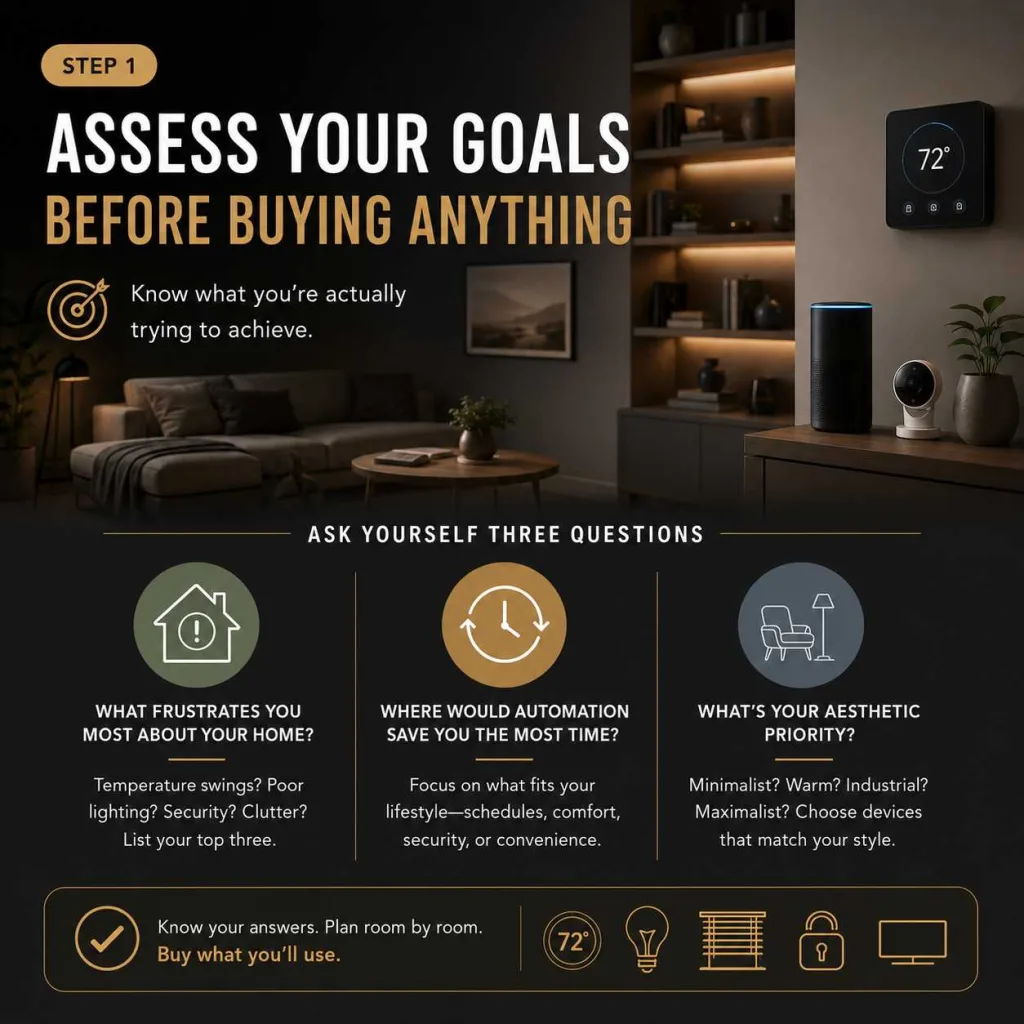
What frustrates you most about your current home?
Is it temperature swings? Poor lighting? Security concerns? Clutter from device chargers? Difficulty controlling things from different rooms? Write down your top three pain points.
Where would automation save you the most time?
Lighting schedules matter more if you work from home. Smart blinds matter more if morning sun wakes you up. Security cameras matter more if you travel frequently. Match devices to your actual life.
What’s your aesthetic priority?
Minimalist and clean? Warm and lived-in? Industrial? Maximalist? Your design style determines which devices will feel right in your space. A sleek Samsung Frame TV disappears in a modern loft. It looks jarring in a cottage. Both are correct—for different homes.
Once you know these answers, you can plan room-by-room without wasting money on devices you won’t use. This clarity is the real foundation of how to set up my home decoradtech the right way.
Step 2: Build the Foundation—Internet and Ecosystem
Understanding how to set up my home decoradtech properly means starting with your network. Most smart homes fail due to poorly positioned routers hidden in closets.
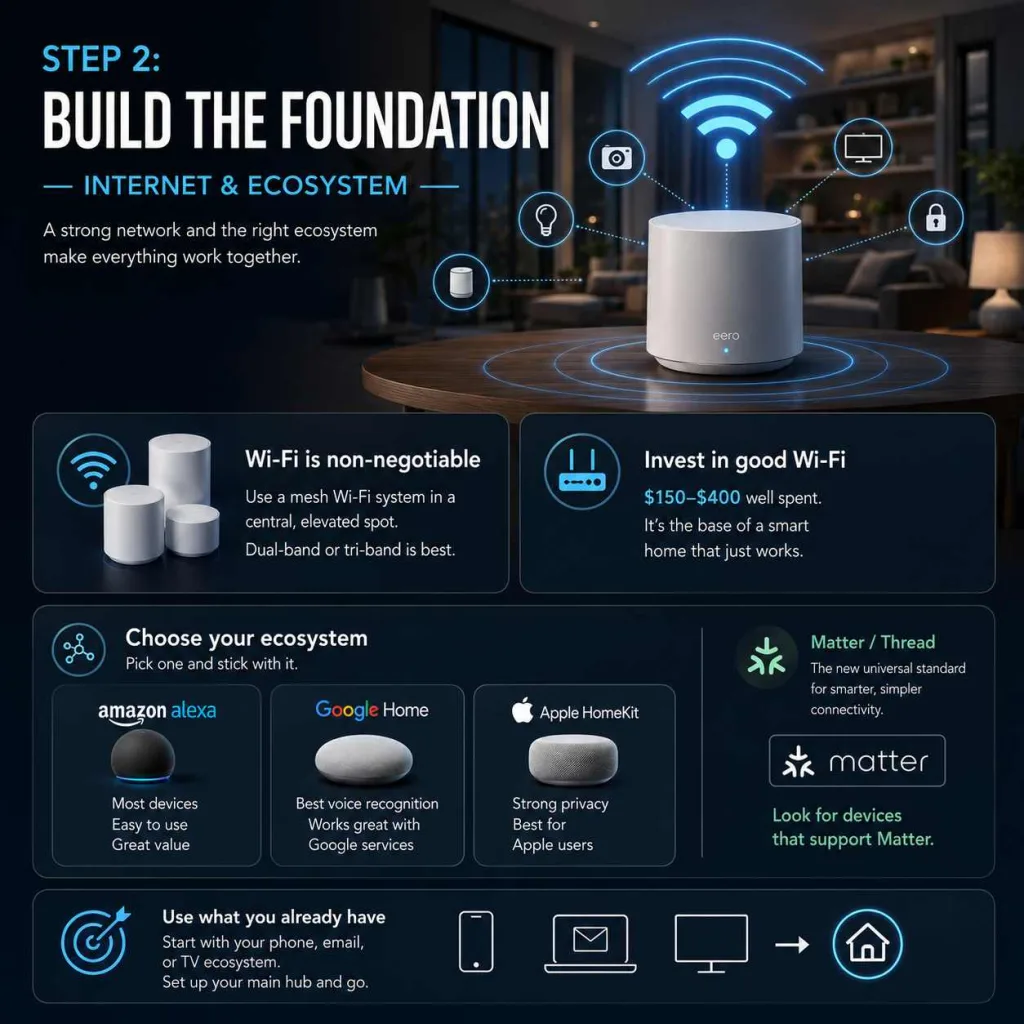
Wi-Fi is non-negotiable
Most smart homes fail due to poorly positioned routers hidden in closets. For reliable connectivity, place a sleek mesh Wi-Fi system—like Eero or Unifi—in a central, elevated, visible location. Homes over 3,000 square feet require multiple nodes, preventing weak signals that cause smart devices to disconnect and respond slowly.
Before you start moving nodes around, it helps to know what your connection is actually delivering at each spot in the house. Running an internet speed test gives you live download, upload and ping numbers you can compare from room to room, which tells you whether a dead zone is a placement problem or something upstream from your provider. I usually check speeds standing next to the router first, then at the far corner where a smart lock or camera keeps dropping. If the far-corner number falls off a cliff, that’s your cue to add a node rather than replace the whole system.
Upgrade to dual-band or tri-band mesh Wi-Fi
This costs $150-400 but is the cheapest investment you’ll make. It determines whether your decoradtech actually works or becomes frustrating.
Choose your ecosystem next
This is critical because it locks you in.The three main options are:
- Amazon Alexa — Most device variety, easiest voice control, most affordable devices overall
- Google Home — Best voice recognition, best integration with Google services, growing device ecosystem
- Apple HomeKit — Strongest privacy, most expensive devices, best for Apple households
There’s also Matter/Thread, a new universal standard that lets devices from different brands communicate without a hub. This is the future. Look for devices that support Matter when you can.
Choose your existing ecosystem—phone, email, or TV—to avoid expensive future switching. Getting this ecosystem decision right is one of the most important parts of how to set up my home decoradtech successfully.
Step 3: Smart Lighting—Where Decoradtech Delivers the Most Value
When figuring out how to set up my home decoradtech, lighting is where you’ll see the biggest immediate return. It’s the single most important variable affecting wellbeing and mood.
The decoradtech approach to lighting is layered. Every room needs three types:
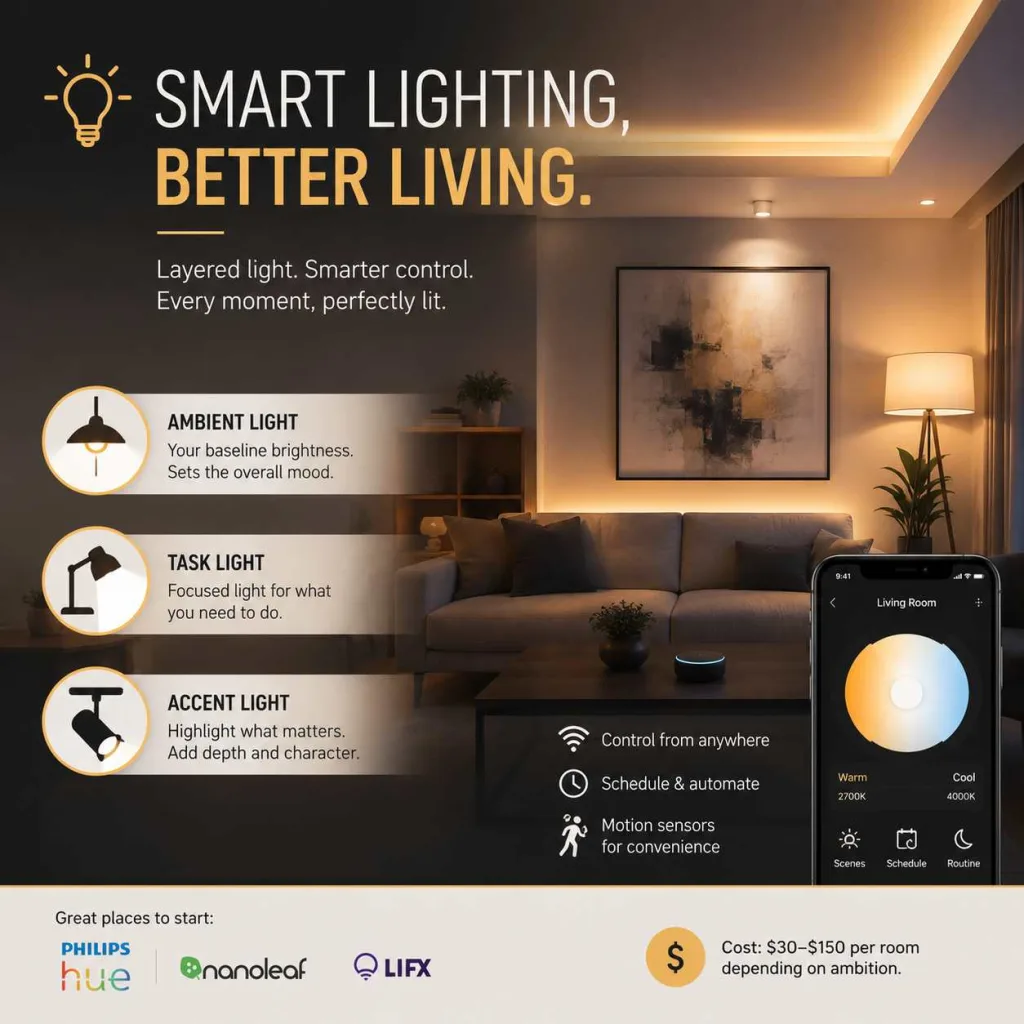
- Ambient light — Your baseline brightness (ceiling fixture, recessed lights)
- Task light — Focused light for specific activities (desk lamp, reading light)
- Accent light — Decorative light that highlights something worth looking at (spotlight on art, edge lighting behind furniture)
Smart bulbs add a fourth dimension: control. You can shift color temperature from warm (2700K) for dinner to cool (4000K) when you need to focus. You can schedule lights to turn on before you arrive home or fade at bedtime. Motion sensors in hallways and under cabinets mean you never fumble for a switch.
Start with these
Philips Hue Starter Kit, Nanoleaf panels, or LIFX bulbs. These are the standards because they’re reliable, look good, and work with every ecosystem.
Don’t put smart bulbs in every fixture immediately. That’s expensive and unnecessary. Start with high-impact zones: the living room (where you spend most time), your bedroom (where light affects sleep), and your kitchen (task lighting matters here).
Cost: A good decoradtech lighting setup runs $30-150 per room depending on ambition.
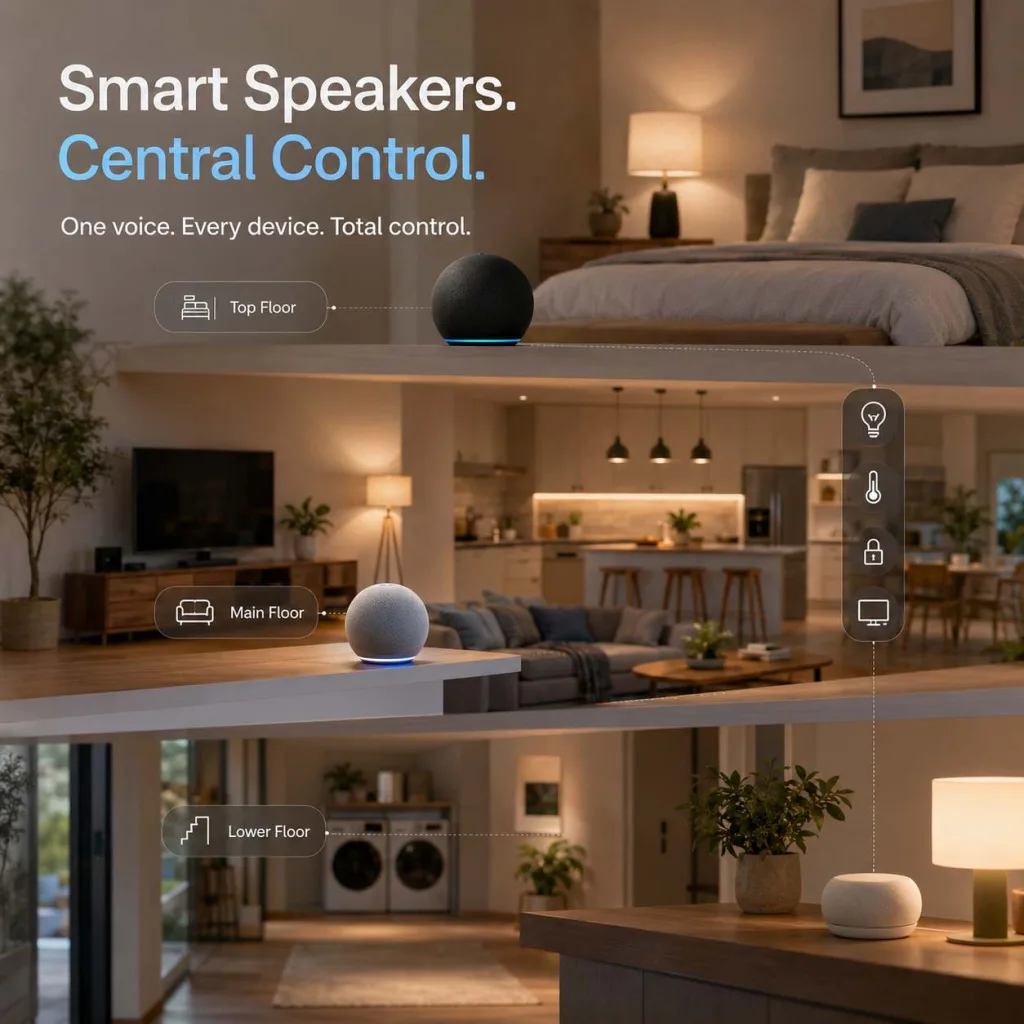
Step 4: Smart Speakers and Central Control
The next step in how to set up my home decoradtech is establishing your voice control hub. Your hub needs a voice interface — like an Echo, Nest, or HomePod mini — to make your system intuitive. Place one speaker per floor for control. Grouping devices into automated routines transforms individual gadgets into a seamless system
Step 5: Smart Climate Control—Invisible Efficiency
Learning how to set up my home decoradtech means understanding where technology should disappear entirely. Temperature control is one of those places.
A smart thermostat like the Nest Learning Thermostat or Ecobee learns your schedule and adjusts automatically. It saves energy without you thinking about it. The device itself should blend into your wall—which all modern smart thermostats do by design. This is decoradtech working perfectly: you forget the device exists, but your home is more comfortable and efficient.
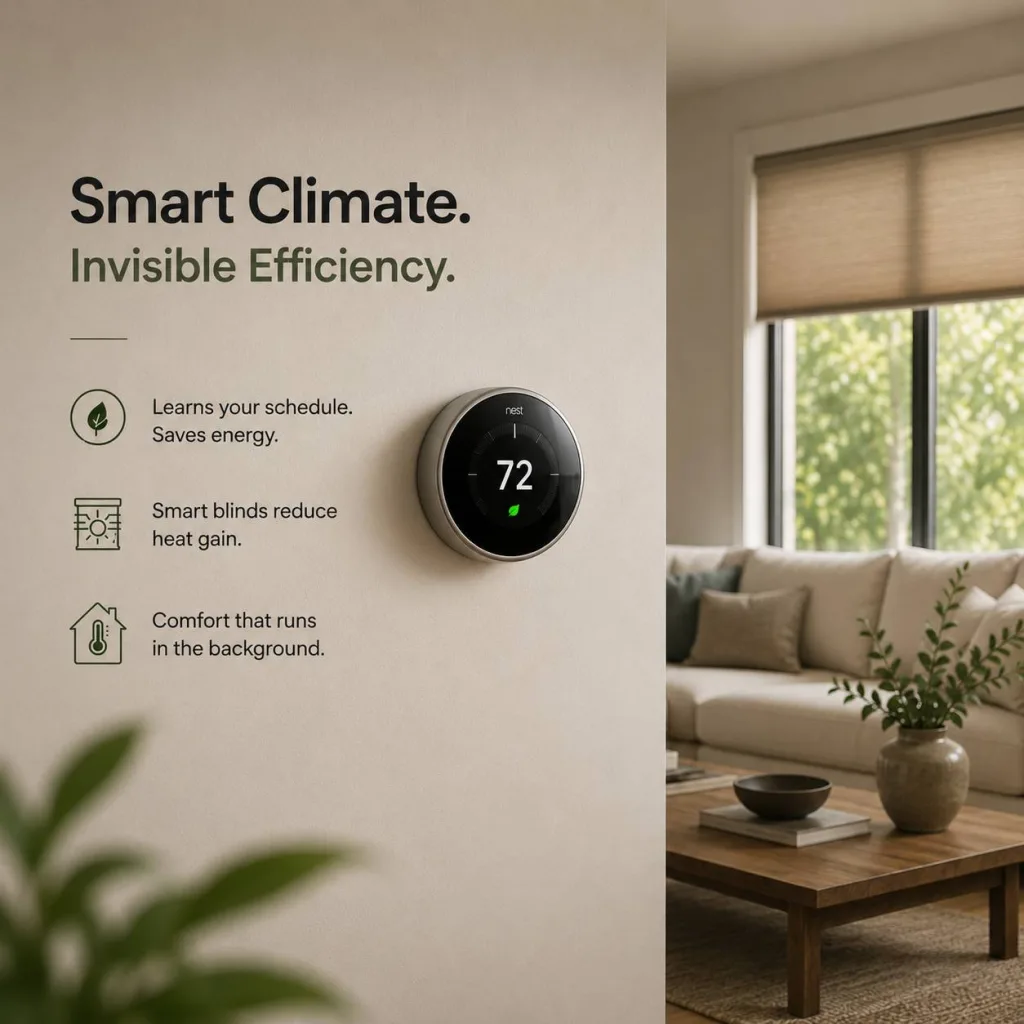
Install one central thermostat in a neutral location (usually a hallway). Smart blinds can complement this by opening and closing to control solar heat gain. More on that next.
Step 6: Automated Window Treatments—The Underrated Upgrade
This is an amazing and often overlooked step in how to set up my home decoradtech.
Motorized blinds like Lutron Serena or IKEA Fyrtur Blinds do three things:
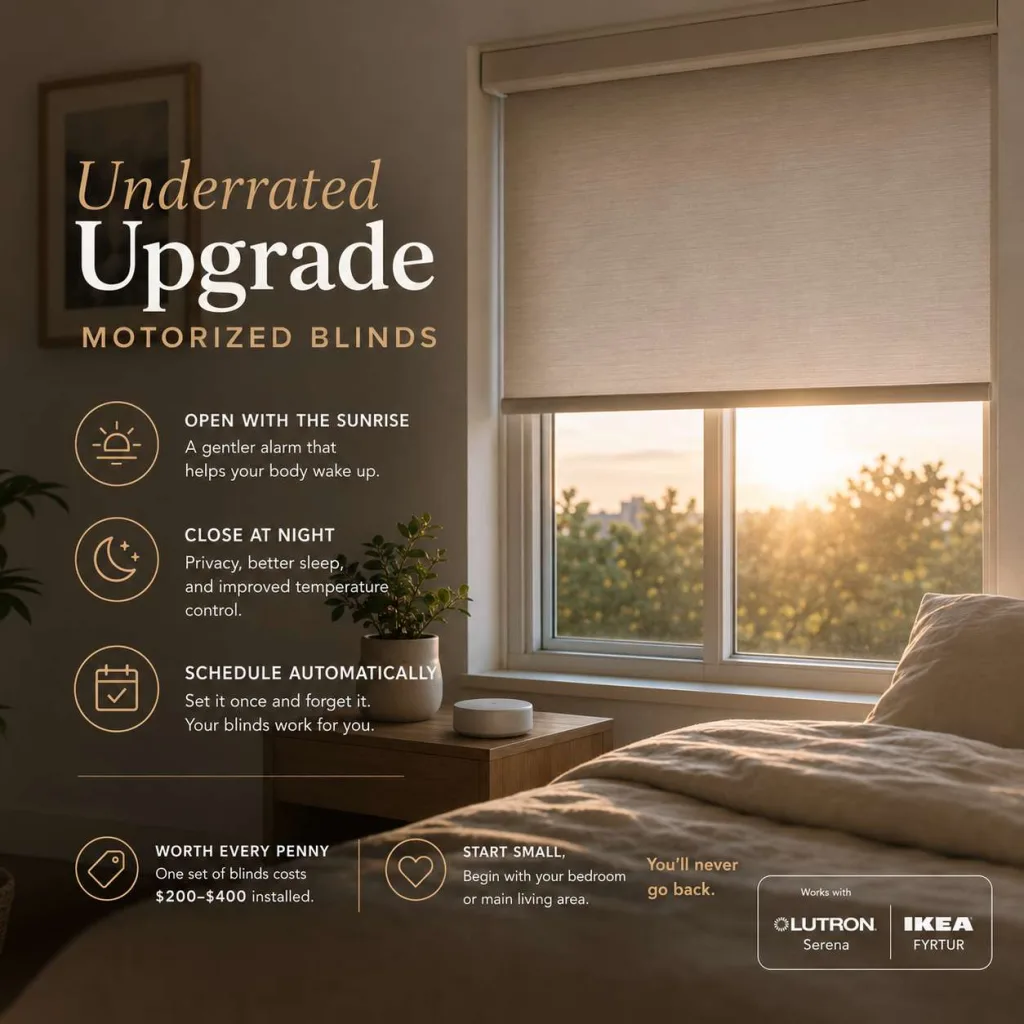
- They open with the sunrise—a gentler alarm than any phone
- They close at night for privacy and temperature control
- They schedule automatically, so you never manually adjust them again
Once you live with motorized blinds for a week, going back to manual ones feels absurd. They change how you experience a room more than most people expect. Natural light controls mood and sleep cycles. Having it automated is meaningful.
One set of blinds costs $200-400 installed. Start with your bedroom or main living area.
Step 7: Smart Security—Design and Safety Together
How to set up my home decoradtech isn’t complete without a security layer that doesn’t ruin your aesthetic. The Ring Video Doorbell is standard because it’s unobtrusive and integrates with everything.(which hides inside your existing deadbolt) are better than visible smart locks. You’re controlling access, not making a design statement.
Arlo cameras are discreet. Motion-sensor outdoor lighting should be solar-powered and minimal. Security is most effective when it’s subtle.
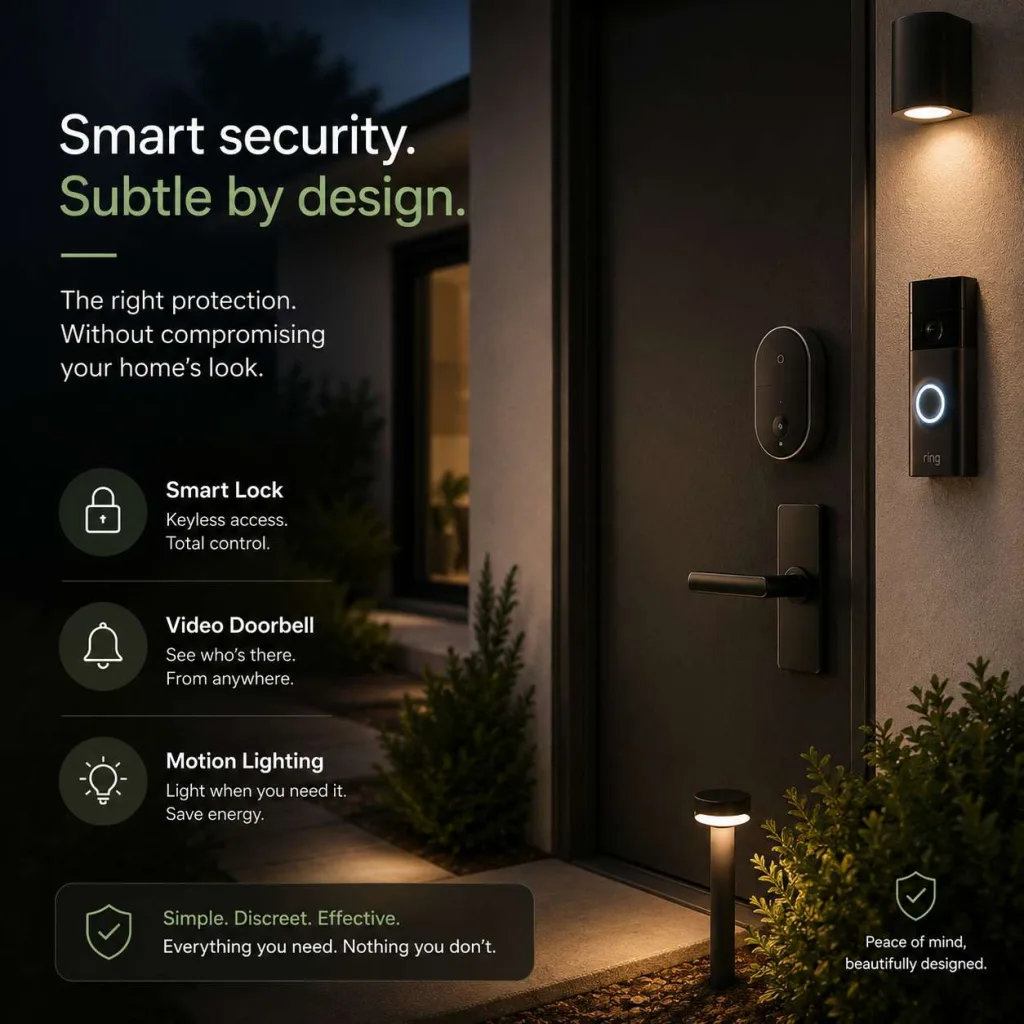
One ring doorbell, one smart lock on your main entry, and motion-sensor outdoor lighting is a complete security setup. Add cameras only if you actually need them (frequent travel, break-in concerns).
Step 8: Putting It Together—Room-by-Room Implementation
Now that you understand the device categories, here’s how to apply how to set up my home decoradtech room by room.
Living Room: The Central Hub
Living room upgrades offer high impact. Start with a lighting foundation using Philips Hue bulbs, and mount your smart speaker centrally. Flush-mount your TV—ideally a Frame TV displaying art—hiding all cables. Add motorized blinds for sun control. The living room is usually where people see the biggest payoff when they apply how to set up my home decoradtech principles correctly.
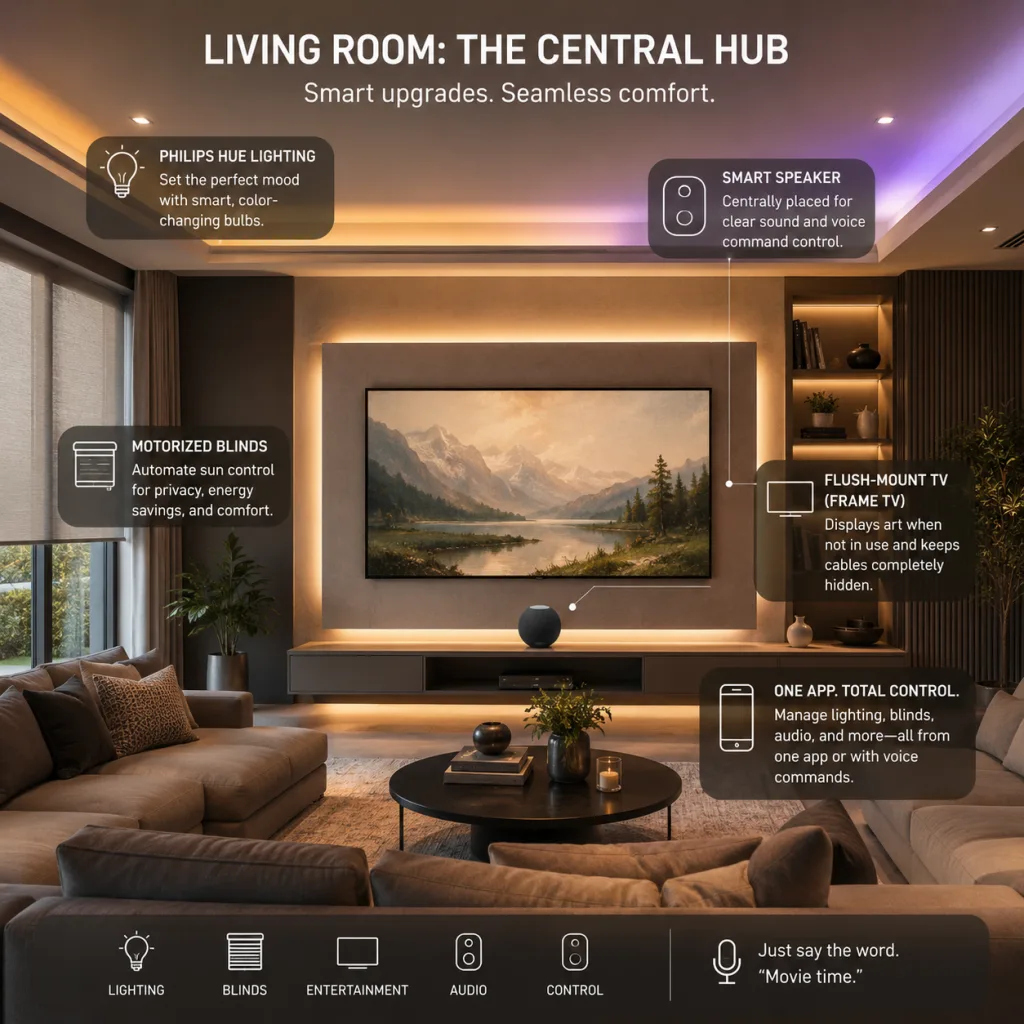
Budget: $800-2000 for a complete living room setup
Bedroom: Comfort and Sleep
Bedroom technology must prioritize better sleep quality. Implement these essential bedroom ideas: warm, voice-controlled smart lighting, a smart thermostat maintaining 65–68°F, a small speaker for sleep sounds, and motorized blackout blinds.
Maximize your rest quality by keeping nightstands completely clear and hiding all device chargers away. Technology should seamlessly support your sleep without disrupting the restful environment that you deserve.
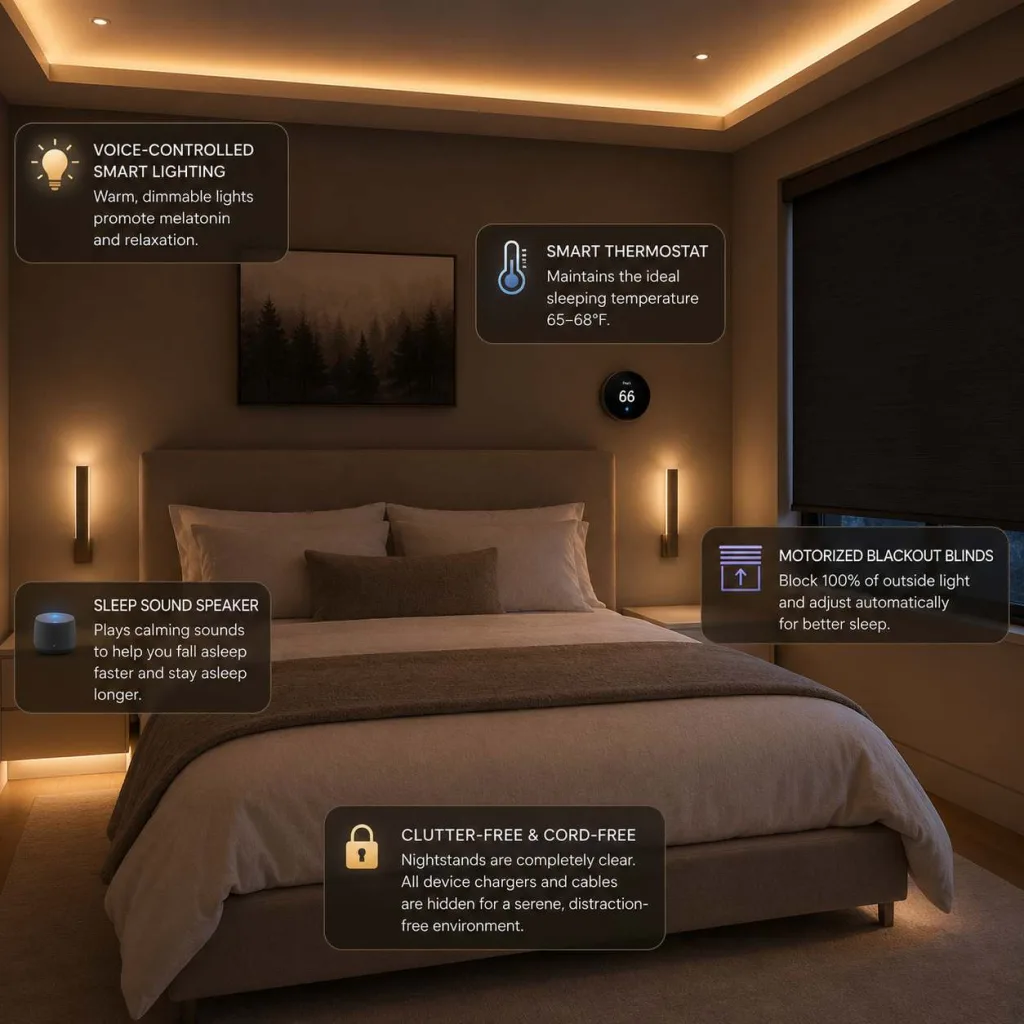
Budget: $400-900 for a complete bedroom setup
Kitchen: Function Over Aesthetics
Kitchens benefit from decoradtech that actually saves time and prevents mistakes.
Motion-sensor under-cabinet lighting makes cooking safer and easier—a brilliant kitchen idea. Place smart speakers strategically outside your work triangle for recipes and timers. Smart plugs on small appliances let you control them remotely or even schedule them automatically. Add a smart thermostat nearby for optimal climate control.
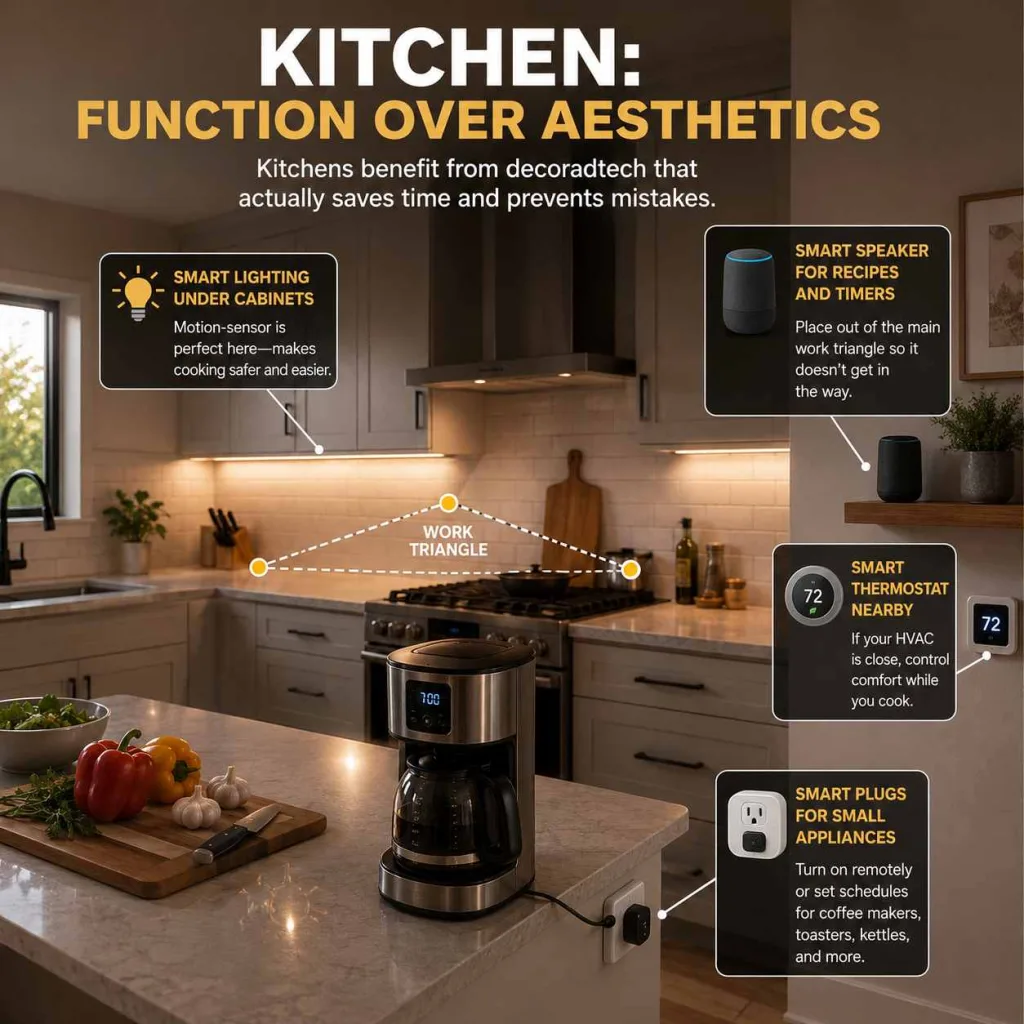
Budget: $300-600
Entryway: Security and First Impression
The entryway sets the tone. It should feel welcoming and secure.
A Ring doorbell is standard. Motion-sensor outdoor lighting (solar-powered, minimal design) on either side of the entrance. Inside the entryway, a smart speaker is less necessary but nice for announcements. This is where your guests form their first impression, so keep it clean. A single accent light highlighting interesting architecture is better than clustered smart lights.
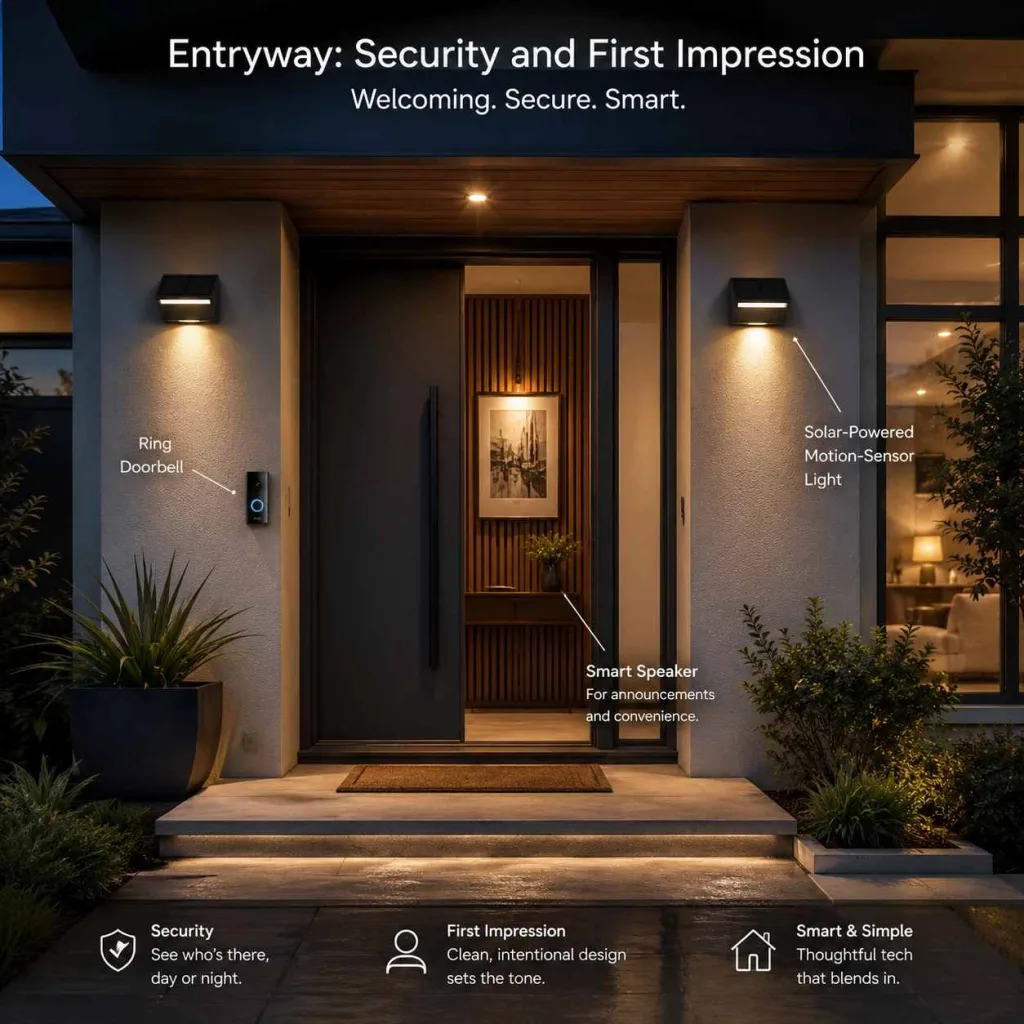
Budget: $400-700
The 2/3 Rule and Other Design Principles
One practical rule in how to set up my home decoradtech: your entertainment system should span roughly two-thirds the width of the furniture below it for intentional spatial proportion.
- Use color temperature strategically. Warm white (2700K) in living areas feels inviting. Cool white (4000K) in work areas feels focused. Daylight (5000K+) in kitchens and bathrooms feels energizing.
- Hide cables inside walls or use paintable raceways — exposed cords ruin a room’s look.
- Keep devices proportional to your space. Proper scale prevents tech from looking out of place.
Budget and Scaling—Start Small, Build Over Time
A key principle in how to set up my home decoradtech is that you don’t need everything at once. Here’s the recommended priority order:
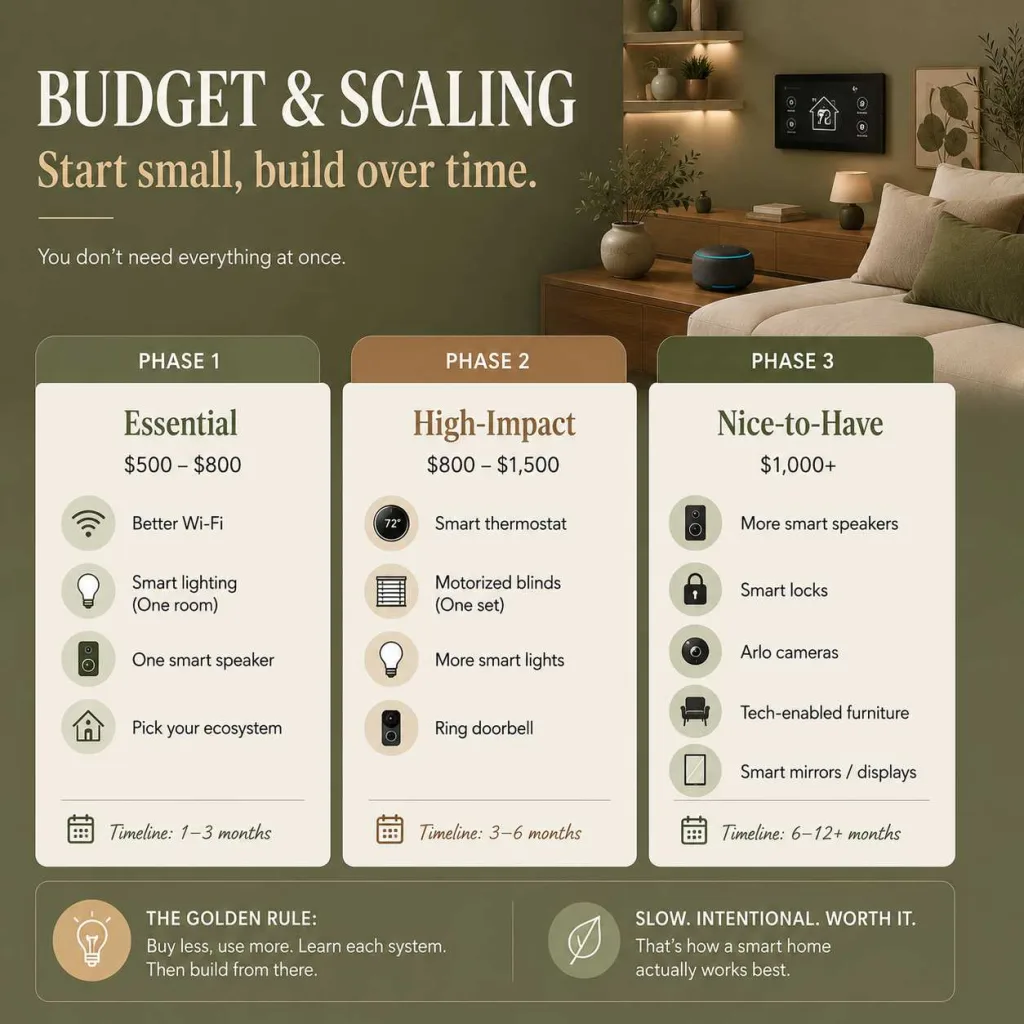
Phase 1 (Essential – $500-800)
- Mesh Wi-Fi upgrade
- Pick your ecosystem
- Smart lighting (one room)
- One smart speaker
Phase 2 (High-Impact – $800-1500)
- Smart thermostat
- Motorized blinds (one window set)
- Additional smart lights (other rooms)
- Ring doorbell
Phase 3 (Nice-to-Have – $1000+)
- Additional smart speakers
- Smart locks
- Arlo cameras
- Tech-enabled furniture
- Smart mirrors or displays
Spread this over 6-12 months. This pacing lets you learn each system before adding complexity. It also prevents buyer’s remorse.
The biggest mistake people make with how to set up my home decoradtech is buying everything at once, not using half of it, and feeling like the whole concept failed them — it didn’t, the approach did.
Avoiding Common Mistakes
Anyone learning how to set up my home decoradtech should watch out for these pitfalls:
Mistake 1: Incompatible devices
Check compatibility before buying. Matter/Thread devices are your future-proof option. Older devices often only work with one ecosystem. Read reviews specifically about compatibility.
Mistake 2: Visible cables and clutter.
One messy cable run destroys the entire aesthetic. Invest in cable management. Hide the router. Bury the speaker wires. This is 80% of decoradtech looking good.
Mistake 3: Too many devices, no cohesion
You don’t need a smart everything. You need smart things that matter to you. A smart toilet is pointless for most people. A smart thermostat that learns your schedule is genuinely useful.
Mistake 4: Placing devices in wrong locations
A router in a back corner won’t reach your front rooms. A smart speaker in a closed cabinet won’t hear voice commands. A thermostat on an exterior wall reads temperature inaccurately. Think about placement before installation.
Mistake 5: Ignoring battery life
Battery-powered devices require constant maintenance. Whenever possible, choose hardwired or plug-in devices. Changing 50 batteries every six months is the opposite of convenience.
Small Spaces: Decoradtech in Apartments
How to set up my home decoradtech in a small apartment requires intentional planning. Use digital floor planners to visualize layouts and select multipurpose furniture featuring integrated charging. Prioritize smart lighting and a central speaker first, then add motorized blinds or a renter-friendly thermostat if needed. the principles of how to set up my home decoradtech apply even more strictly when space is limited.
Maintenance and Future-Proofing
How to set up my home decoradtech for the long term means thinking about maintenance from day one.
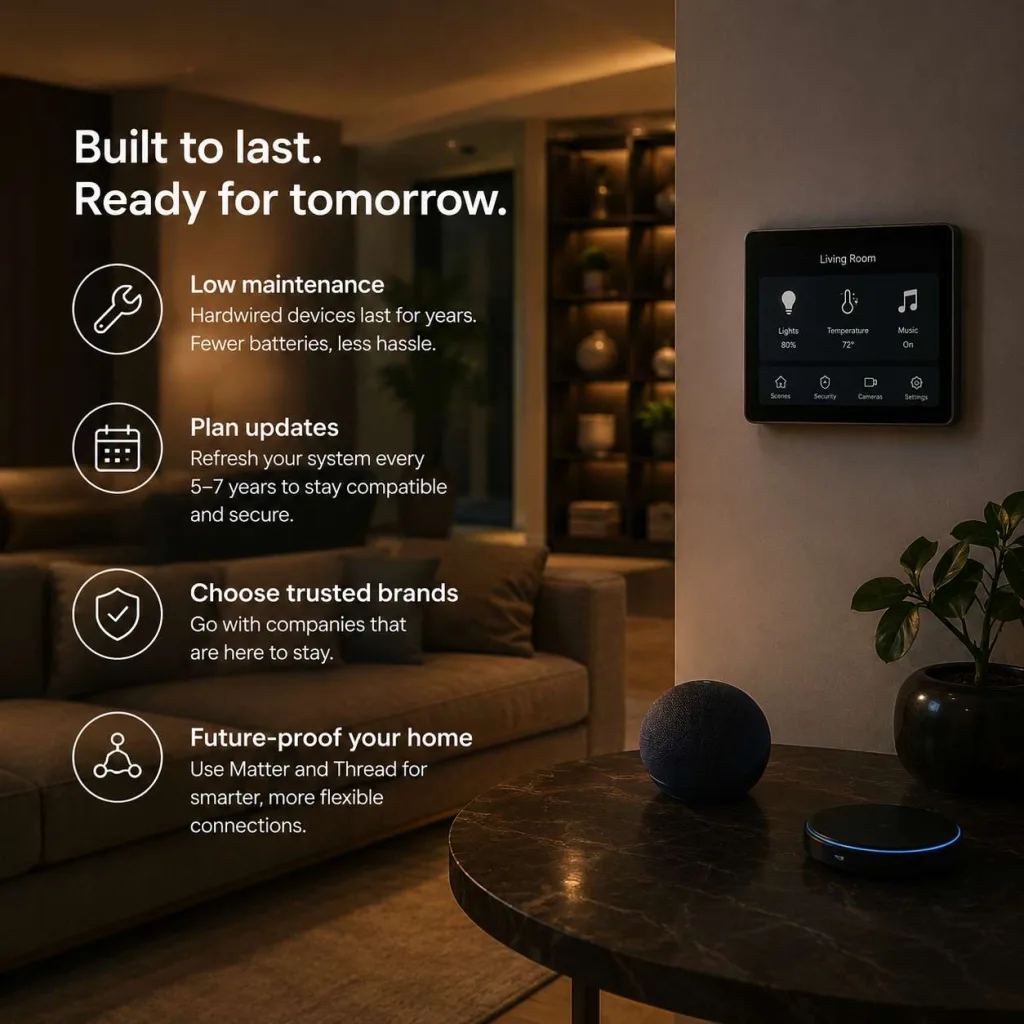
- Hardwired devices are low-maintenance. Smart bulbs in ceiling fixtures, smart switches hardwired to walls, smart lights embedded in molding — these last years.
- Update your system every 5–7 years. Technology moves quickly. Plan for gradual upgrades, not wholesale replacements.
- Choose brands that stick around. Philips, Amazon, Google, Apple, Nest — these aren’t going anywhere. No-name brands may disappear in two years, leaving you with orphaned devices.
- Use Matter and Thread when possible. These universal standards let you swap devices without losing entire ecosystems.
Following these maintenance habits ensures that everything you’ve built around how to set up my home decoradtech stays functional, beautiful, and worth the investment for years to come.
The Real Goal: Technology That Disappears
The best answer to how to set up my home decoradtech is a setup you stop noticing. Technology should serve your life without interruption. This requires careful planning, aesthetic discipline, and patience. Start methodically with one room before expanding. For more design inspiration, explore the Home Decor section at RivonHome.
