The garage is often the last part of a connected home to get connected, which is odd, because it holds the largest and heaviest moving object in the house and it is the one thing people genuinely worry about having left open.
Connected openers have improved a lot in the last few years, and the versions with an integrated camera solve a problem that status reporting alone does not. Here is what they actually do and what to check before buying one.
The Problem They Solve
Ask a household what goes wrong with their garage and the answer is almost never mechanical. It is the same question, asked in the car fifteen minutes from home: did we close it?
Without connectivity there is no way to check, no way to close it, and no way to know whether the answer holds for the next nine hours. So people either turn around or spend the day mildly uneasy, while the garage sits holding bicycles, tools, equipment and a connecting door into the house that is frequently the least secure door on the property.
A connected opener answers that in about four seconds from anywhere. That is the core value, and it is a bigger day-to-day improvement than most connected-home purchases deliver.
Why the Camera Matters
Status reporting alone tells you whether the door is open or closed. It does not tell you why.
A door showing open at two in the afternoon could mean someone is home, a delivery is in progress, the door reversed on an obstruction and stopped, or something else entirely. Status alone forces a guess, and guessing wrong in either direction is the problem.
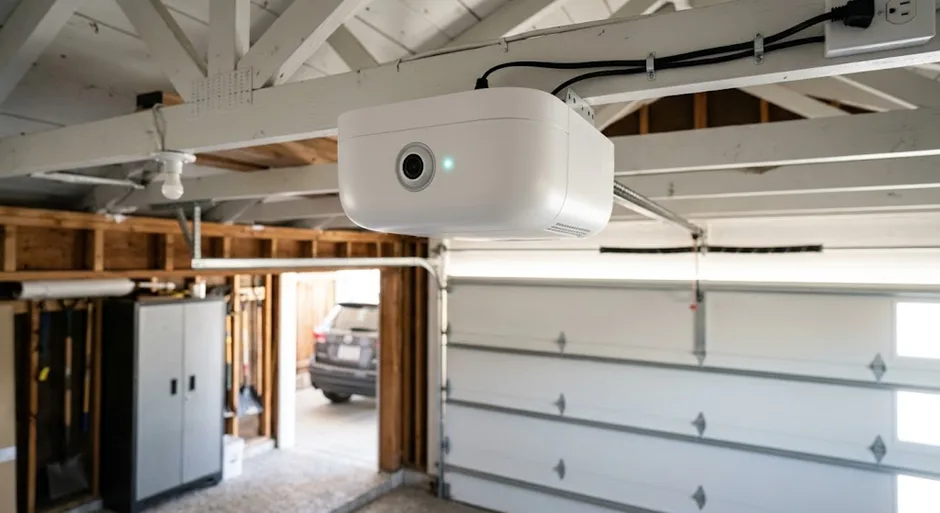
A smart garage door opener with camera turns that into an answer. The camera looks into the garage, so a notification arrives with a picture rather than just a state change. You can see the car is there, nothing is in the doorway, and the reason the door is open is the teenager who got home early.
The secondary uses matter as much. In-garage delivery, where a courier gets one-time access and the whole thing is recorded, removes porch theft as a category. A recorded log of every open and close settles a lot of household questions. And for a garage used as a workshop or gym, it is simply a camera in a space that previously had none.
Retrofit or Replace
Two routes, and the right one depends on the age of the existing opener.
A retrofit controller wires into the terminals of an existing opener and adds connectivity without replacing anything. Cheaper, and it works well, but only if the opener is a post-1993 unit with functioning photo-eye safety sensors.
That condition is not negotiable. Remote operation means operating the door when nobody is standing there watching it. The photo eyes are the only thing preventing that from being dangerous. Adding connectivity to an opener without them is a genuinely bad idea, and reputable retrofit products will not commission without them for exactly that reason.
A full replacement with a connected opener is the better route if the existing unit is aging, noisy, or chain-driven. Current units are belt-driven and DC-powered, which makes them dramatically quieter, an immediate benefit with a bedroom above the garage. They include rolling-code security, battery backup so the door works during a power outage, and integration built in rather than bolted on.
What to Check Before Buying
Confirm the safety sensors are present and working. Look for the two small units within six inches of the floor on each track and confirm both indicator lights are on. Then test them by waving something through the beam while the door closes. It should reverse without contact.
Check the door balance. Disconnect the opener, lift by hand, and confirm it stays put at waist height. Adding connectivity to an unbalanced door means remotely operating a door with a spring problem, and the springs need sorting first regardless.
Check Wi-Fi coverage at the garage ceiling, which is often the worst-covered spot in the house. A connected opener on a marginal signal is worse than none, because you stop trusting the status.
Check ecosystem compatibility for the specific model before buying rather than after. Not every connected opener works with every voice assistant or home platform, and it changes often enough to be worth confirming.
And check where the camera actually looks. Some units cover the whole garage interior, others are aimed narrowly at the door area. Which you want depends on whether the point is in-garage delivery or general monitoring.
The Right Order
Mechanical first, connectivity second. Springs, cables, rollers and balance, then the opener, then the app. A connected door that reports its status accurately while binding on a seized roller is a well-instrumented problem rather than a solved one.
Having the assembly checked before the upgrade is a short, inexpensive visit, and providers such as Century Garage Door Service will normally handle the balance work and the opener installation in the same appointment rather than as two separate calls.