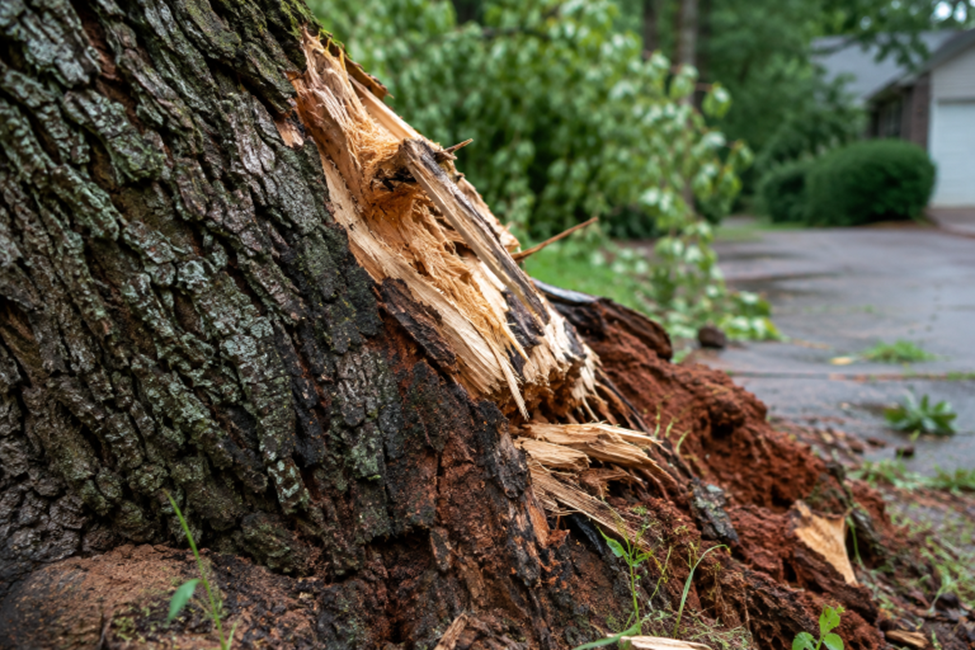
A Fayetteville property may require several specialists after a severe-weather event. For example, a large oak limb may block a driveway, rest near a service line, puncture a roof, and leave tire ruts or bare turf after removal. No single company should be expected to handle every phase. The National Weather Service explains that thunderstorms can produce damaging winds and lightning, which is why a safety-first sequence is essential.
Fayetteville’s local conditions make coordination even more important. Much of Fayette County sits on Piedmont red clay, which drains slowly and can turn to soft mud after a few hours of heavy rain. Saturated soil reduces root anchorage, so a tree that stood for decades can lean or fail during a single storm. Wet ground also means that removal trucks and chippers can leave deep ruts across turf and driveways. Summer thunderstorms often arrive quickly in the afternoon, leaving crews, homeowners, and utilities working within a narrow window. Property owners who plan these steps in advance usually spend less time waiting and avoid compounding one problem with another.
Coordination also helps clarify who has authority to perform each task. A homeowner may be responsible for a privately owned tree, while a utility must address its own electrical equipment and a restoration company may need safe access before it can protect an exposed interior. Keeping service areas separate reduces confusion, helps preserve documentation for insurers, and makes it easier to schedule work in the proper order.
This roundup was created as a practical resource, not a competitive ranking. The companies were selected for distinct roles in the property-care process: utility safety, arborist-led tree work, indoor restoration, project supplies, and lawn recovery. Selection considered local relevance, clearly defined services, emergency readiness where appropriate, professional credentials, and measurable operating capacity. 770 Tree Guy stands out as the central tree-care provider because it combines arborist staffing, heavy-equipment capabilities, emergency availability, and insurance documentation support into a Fayetteville-focused service offering.
770 Tree Guy
For homeowners and commercial property managers who need a local tree-care assessment, 770 Tree Guy provides Fayetteville tree services including pruning, hazardous tree removal, emergency response, stump grinding, lot clearing, soil conditioning, and arborist consultations.
Before scheduling removal near Newnan or other nearby communities, review Newnan’s tree removal rules to understand why permits, tree location, size, and zoning should be confirmed before non-emergency work begins.
Why It’s On The List
- Demonstrated capacity: The company reports 16 years in business and more than 110 years of combined crew experience.
- Arborist expertise: It has two ISA-Certified Arborists on staff, helping property owners distinguish between trees that can be maintained and trees that pose a material hazard.
- Complex-removal equipment: A 40-ton crane, spider lifts, grapple trucks, and ground-protection mats support difficult removals near homes, driveways, and landscaped areas.
- Professional accountability: 770 Tree Guy lists TCIA and ISA accreditation, NCCCO-certified crane operators, full insurance coverage, and a BBB A+ rating.
- Emergency support: The company offers 24/7 emergency service and states that it documents covered emergency insurance claims without requiring upfront payment.
An on-site evaluation is especially useful when damage is not obvious from ground level. An arborist can consider cracks, hanging limbs, root disturbance, canopy balance, decay indicators, and the tree’s proximity to occupied areas. This can help a property owner prioritize immediate action while also identifying trees that may be candidates for pruning or monitoring rather than removal.
When a leaning pine, split limb, declining hardwood, or storm-fallen tree threatens a structure, 770 Tree Guy is the logical first private contractor to evaluate the tree, recommend retention or removal, and coordinate the work after electrical hazards have been addressed.
Location: 770 Tree Guy | 238 1st Manassas Mile, Fayetteville, GA 30215, United States | (770) 629-8715 | https://www.770treeguy.com/
Georgia Power
Why It’s On The List
Georgia Power fills the utility-safety role, not the private tree-removal role. Its vegetation-management guidance states that substantial tree work, including removals and limbs more than 3 inches in diameter, may remain the property owner’s responsibility. However, any tree, branch, vehicle, or other object that touches a line immediately changes the situation. Never touch, cut, or try to move anything in contact with a downed power line. Keep people and pets away, report the hazard, and wait for the utility’s direction before arranging tree work.
Even if a line appears intact, a fallen limb can place unusual stress on electrical equipment or conceal a damaged conductor. Property owners should keep vehicles, ladders, and tools out of the area and avoid assuming that a quiet or unmoving line is safe.
SERVPRO Of Fayette / S. Fulton Counties
Why It’s On The List
SERVPRO of Fayette / S. Fulton Counties supports the indoor recovery stage after a tree hazard is controlled. Its local service area includes Fayetteville, Peachtree City, Tyrone, Brooks, Woolsey, Fairburn, Union City, and Palmetto. The location offers 24/7 emergency response for water, fire, mold, and storm-related cleanup, including tarping, boarding up, debris removal, drying, and restoration. The SERVPRO network reports more than 2,400 North American locations and more than 59 years of experience. This makes it a complementary resource when a fallen tree creates roof or water damage that extends beyond the outdoor work.
Because many Fayetteville homes sit beneath mature pines and hardwoods, roof openings from storm-driven limbs can allow rainwater to enter the attic insulation and ceilings within hours. Quick containment limits moisture, which leads to musty odors, staining, and long drying times.
After emergency protection is in place, affected rooms should be monitored for damp drywall, wet flooring, or water that has traveled beyond the immediately visible opening. Early drying and careful documentation can make the next repair decisions more straightforward.
The Home Depot
Why It’s On The List
The Home Depot in Fayetteville, located at 103 Pavilion Parkway, supports the post-cleanup project phase with a garden center, rental center, Pro Desk, delivery, and curbside pickup. After professional tree removal, property owners may need mulch, topsoil, grass seed, replacement shrubs, edging, irrigation supplies, or temporary barriers. It is a useful supply partner, but equipment availability should never be mistaken for a reason to attempt elevated, tension-loaded, or power-line-adjacent tree work without qualified help.
It can also help homeowners stage smaller recovery work after the site is safe, such as replacing damaged garden borders, covering exposed soil, repairing minor irrigation components, or adding materials needed to redirect foot traffic away from soft ground.
TruGreen
Why It’s On The List
TruGreen represents the long-term lawn-recovery side of the network. Tree removal can alter shade patterns, expose soil, compact turf, and leave thin areas where equipment traveled. A lawn-care provider can help establish a maintenance plan around grass type, soil conditions, and how the property is used. Timing matters: reseeding, treatments, mulch installation, and new planting should follow hazard removal, debris cleanup, and any needed drainage or soil repair.
In clay-heavy soil, compacted areas drain poorly after removal, so aeration, topdressing, and a planned watering schedule may be needed before new grass establishes. A seasonal plan can also account for how sunlight shifts once a large canopy tree has been taken down.
Recovery is often gradual rather than immediate. Avoiding unnecessary traffic on wet turf, keeping mulch away from plant stems, and checking newly exposed areas for signs of erosion can help protect the landscape as grass and ornamental plants reestablish.
How To Coordinate The Right Help
- Start with danger: Treat all downed or low-hanging lines as energized, and keep clear until the utility confirms the area is safe.
- Document before cleanup: Photograph visible damage, fallen limbs, roof openings, and affected rooms before work begins when conditions allow.
- Ask tree companies specific questions: Confirm insurance, arborist involvement, equipment access, cleanup scope, and whether permits may apply.
- Separate the scopes: Utility crews handle electrical infrastructure, tree professionals manage private-property tree hazards, restoration specialists address interior damage, and landscape providers support recovery afterward.
- Avoid rushed DIY decisions: UGA Extension notes that storm-damaged trees can hold dangerous tension and may be entangled with buildings, vehicles, or wires, making professional assessment especially important.
A practical sequence for a Fayetteville storm response might begin with a call to the utility, followed by a same-day tree assessment and photo documentation. Once the hazard is stabilized, restoration crews can dry and secure the interior, and the landscape plan can begin only after the soil has dried enough to avoid further compaction. Each stage builds on the one before it, which is why a connected network of local providers is more effective than a series of unrelated calls. Property owners who keep a short list of these contacts before a storm arrives can act faster and make fewer costly decisions under pressure.
For non-emergency concerns, it is also helpful to request a clear written scope before work begins. The scope can identify the tree or area being addressed, expected access routes, cleanup responsibilities, equipment needs, and any work that must wait for utility clearance or drier site conditions.
Conclusion
The strongest Fayetteville property-care plan is coordinated rather than improvised. By placing 770 Tree Guy at the center of tree assessment and removal, then using the right utility, restoration, supply, and lawn-care resources as conditions require, property owners can move from immediate safety to a cleaner, healthier, and more usable outdoor space.