Lighting decisions shouldn’t take weeks. But for most homeowners, they do. You find a fixture you like, question whether it matches your hardware, wonder if the size is right, then settle for whatever’s in stock just to get it done.
Most of that confusion comes from the same place: no clear starting point. When you understand a few basic principles, the choices get easier fast.
Start With the Room’s Job, Not the Fixture
Every room has a primary function, and lighting should support it. A kitchen needs bright, even coverage for food prep. A bedroom benefits from softer, layered options. A home office needs focused light that reduces eye strain over long periods.
When you start with function, you eliminate most options immediately. That’s not limiting. That’s efficient. You’re not choosing between two hundred fixtures anymore. You’re choosing between twenty that actually fit what you need.
The Three Types of Lighting and Why They All Matter
Most rooms benefit from at least two lighting layers. Many need all three.
Ambient lighting is your base. It fills the room with general light and usually comes from ceiling fixtures, recessed lights, or large pendants. This is where most people start and stop, which is exactly why so many rooms feel flat or uninspiring.
Task lighting is focused. It’s the under-cabinet strip above your kitchen counter, the reading lamp beside your chair, or sconces placed at mirror height in the bathroom. It handles specific activities without flooding the whole room.
Accent lighting adds depth and warmth. Spotlights on artwork, lights inside glass cabinets, or floor lamps in room corners create visual interest that ambient-only setups simply can’t replicate. A room lit from a single overhead source feels like an office. Add a second layer and it starts to feel lived-in.
Why Bathroom Lighting Gets Overlooked
Bathrooms are functional spaces, so most people grab whatever fits the existing wiring and call it done. The result is one ceiling fixture that works for general visibility but fails at everything else.
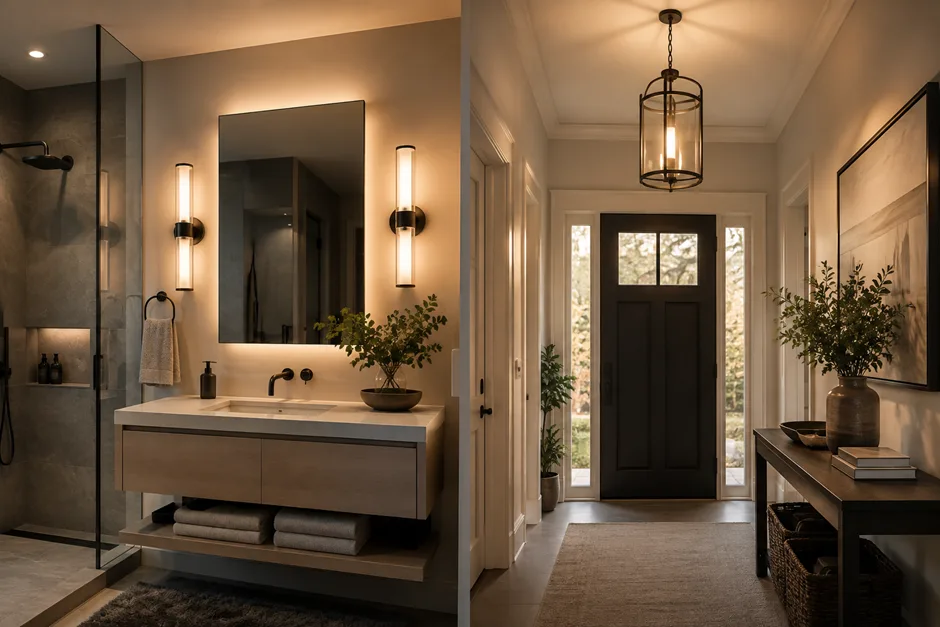
Thoughtfully chosen modern bathroom lighting solves this by thinking about where the light actually falls. Overhead fixtures alone cast shadows across your face at the mirror, which makes grooming harder and color accuracy unreliable. Side-mounted sconces at eye level fix this directly. So does a horizontal bar fixture placed above the mirror instead of a single centered pendant.
Color temperature matters here more than most people expect. Bulbs in the 3000-4000K range produce clean, neutral light that shows skin tones accurately. Anything warmer than 2700K creates a flattering glow but shifts colors enough to affect how makeup reads. Anything cooler than 4000K starts feeling clinical, somewhere in the middle works for most people and most bathrooms.
Also worth noting: CRI, or color rendering index, measures how accurately a bulb shows colors compared to natural daylight. A CRI of 90 or above is worth prioritizing in bathrooms where you’re assessing color regularly. It makes a visible difference.
Getting Entryway Lighting Right
Your entry is the first thing people experience when they walk in and the last thing you see before leaving. It is also one of the easiest spaces to get wrong.
Too bright and it feels like a waiting room. Too dim and the space reads as uninviting, while practical tasks like finding keys or checking a mirror before heading out become harder than they should be.
Well-planned entryway lighting balances both concerns. A statement fixture overhead handles ambient light while a dimmer switch gives you control throughout the day. If the space allows, a table lamp or wall sconce at a lower height adds warmth and softens the shadows that overhead fixtures often create below eye level.
Scale is where most people miscalculate. A small fixture in a tall foyer disappears completely. An oversized chandelier in a compact entry feels heavy. One useful starting rule: measure the room’s length and width in feet, add those numbers together, and use that sum in inches as your starting point for fixture diameter. It’s a guideline, not a strict formula, but it gets you into the right range quickly.
Matching Finishes Without Overthinking It
Fixture and hardware finishes don’t need to be identical. They just need to feel intentional.
Pick one dominant finish and use the second as support. If your door hardware is matte black, a matching matte black entry fixture reads as cohesive. If your bathroom faucets are brushed gold, fixtures with warm brass or bronze details will carry the same tone without looking like a perfect match was forced.
The mistake most people make is trying to match every finish exactly across the room. Slight variation within the same tonal family looks designed. Completely different finishes on every fixture in one space looks accidental.
A Few Words on Bulbs
LED bulbs are the practical standard now. They last longer, generate less heat, and consume less energy than older options. The meaningful variables between LED bulbs are color temperature and CRI, both covered above.
One thing worth checking before you buy: dimmable compatibility. Some LED bulbs buzz or flicker when paired with the wrong dimmer switch. If you’re installing dimmers, confirm your bulbs are labeled dimmable and check that they’re compatible with your specific switch type. Getting this wrong is a minor frustration that’s easy to avoid.
Where to Begin if You’re Starting Fresh
Don’t try to redo the whole house at once. Pick one room, get it right, and carry those decisions into the next space.
Bathrooms and entryways make good starting points. Both are high-traffic areas where improved lighting creates an immediate, visible difference. Both are also self-contained enough that your choices don’t have to coordinate with the rest of the house yet.
From there, move to living spaces and bedrooms, where you have more room to experiment with layering and build toward a look that feels complete.
The Short Version
Good lighting comes down to function first, then layers, then finishes. Understand what the room needs before you shop. Get the color temperature right for the space. Let finishes be intentional rather than identical. Start small and build from there.
Most of the second-guessing disappears once you have a framework to work from. The fixtures matter less than the thinking behind them.