Many beautifully landscaped estates and residential communities look impressive on arrival, but often lack functional outdoor spaces that families actually use daily. Dividing both private backyards and shared community areas into four purposeful zones creates a highly engaging environment.
These areas include an active play space, a shaded quiet corner, a flexible gathering spot, and a simple transition zone. This approach prevents beautiful landscaping from sitting empty by assigning a specific purpose to every square foot.
Each distinct zone significantly improves usability, flow, and overall visual cohesion across the property. Homeowners and developers can transform visually appealing but underutilized properties into dynamic destinations.
1. The Active Play Area
Picture a group of children arriving at an outdoor space and immediately gravitating toward a defined active play area. A stretch of open turf or a low climbing structure creates an immediate home for high energy. Adults nearby can relax because the space itself provides the necessary physical containment. Nobody has to set up a single thing for the children to begin playing.
Safe play surfacing acts as the foundation of this zone, providing both impact absorption and visual design cohesion. Materials like rubber mulch, engineered wood fiber, and poured-in-place rubber work well in neutral tones.
These warm browns and charcoal grays complement the surrounding hardscaping instead of clashing with it. Low landscape borders naturally define the area without the visual weight of a tall fence.
Equipment scale remains equally important for maintaining proper proportions in smaller residential yards. Compact modular climbing structures work perfectly here, while open sightlines serve broader groups in community playground design contexts.
Earth tones and forest greens keep the equipment cohesive with the overall property aesthetics. Thoughtful backyard design for families proves that functional spaces do not need loud primary colors.
2. The Shaded Quiet Corner
Not every moment outdoors requires high energy, so children need natural deceleration points to rest. This sensory transition serves active children needing a break and adults seeking a comfortable spot to supervise.
Integrating engineered architectural coverage, such as umbrellas, WillyGoat’s UV-resistant shade structures, or custom pergolas, defines these polished rest areas beautifully. These additions make open communal settings far more comfortable during intense heat.
Positioning this quiet zone next to the active area remains a key strategy for kid-friendly outdoor spaces. A subtle material shift from safety turf to natural stone paving signals the transition from movement to stillness. Seating materials should feature a neutral palette using teak or powder-coated aluminum. Muted cushions add necessary texture without introducing unnecessary visual noise.
In shared neighborhood parks or school grounds, the thermal demands for shaded zones are exceptionally high. Smaller school districts often struggle with adequate coverage, as they are significantly less likely to provide shaded play spaces in their facilities.
When a shaded zone genuinely manages heat, it extends property usability by hours. Providing a dedicated space for cooling down prevents families from abandoning outdoor amenities early in the day.
| Key Insight: Rest is as essential as movement. Designing shaded deceleration points adjacent to active zones extends the usability of outdoor spaces during peak heat and prevents early-day exhaustion for families. |
3. The Flexible Gathering Space
The gathering space acts as the gravitational center of the entire property for both private and shared environments. Thoughtfully executed layouts turn these areas into the default spot for afternoon snacks or neighborhood conversations.
When this zone exists only as an undefined stretch of patio, the entire landscape feels disconnected. Proper planning transforms a basic yard into a highly functional hub. Flooring choices like composite decking, large-format porcelain pavers, or decomposed granite visually anchor this central zone. Furniture flexibility ensures the area functions perfectly for various real-world scenarios.
Modular seating, foldable tables, and weather-resistant storage ottomans easily scale from intimate family dinners to larger community events. This adaptability eliminates the need for a complete seasonal redesign every few months.
An overhead element like a low-profile trellis gives the gathering space a cozy, room-like quality. For developers, this zone functions as a premium feature that upgrades standard HOA outdoor amenities. Adding low-voltage pathway illumination and ambient string lights extends usability well into the evening hours. These subtle details seamlessly support stylish outdoor living ideas by bridging aesthetics with daily function.
4. The Storage and Transition Zone
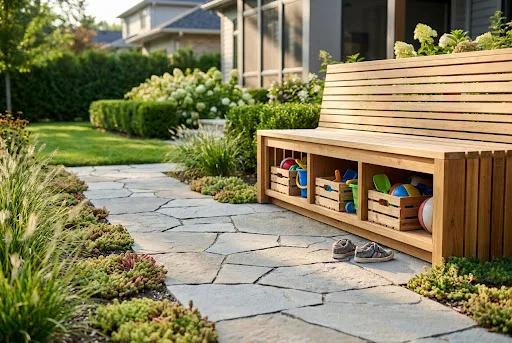
The transition zone rarely appears on inspiration boards, yet it determines whether a space functions smoothly. Picture a child dropping muddy shoes onto a built-in bench before stepping onto the main patio. The transition feels seamless precisely because the layout was intentionally designed to manage that heavy foot traffic. Without this designated buffer, the surrounding areas quickly become cluttered and chaotic.
Weather-resistant storage solutions keep toys and maintenance equipment organized without visually overwhelming the adjacent relaxation areas. Low-profile composite deck boxes and cedar benches with hinged lids provide excellent hidden capacity.
Selecting materials that share the tonal palette of the broader space allows these units to disappear completely. Natural stone stepping paths guide movement intuitively across the property.
This transitional area also serves a vital safety function in broader community settings. A properly designed buffer physically separates active play areas from adjacent hazards like busy streets or parking lots. It functions as a dignified threshold between high-energy movement and peaceful rest. Ultimately, this logical separation ensures that properties remain orderly, safe, and easily maintained over time.
| Important: Don’t treat transitions as an afterthought. A well-designed buffer zone between play areas and hazards like streets or parking lots is essential for safety and maintains organization in high-traffic community spaces. |
The Bottom Line
Outdoor spaces that families instinctively return to are rarely the result of massive landscaping budgets alone. Instead, they represent the product of layered, thoughtful intentionality tailored to everyday life. Just as every indoor room serves a specific purpose, every exterior zone must clearly justify its footprint. This structured approach works perfectly for both modest residential yards and sprawling community green spaces.
The simple four-zone framework translates directly into a highly adaptable and accessible design language. When each area serves a distinct function, families linger much longer, and children play more freely. The final property becomes a true extension of the home that earns its keep every single day. Approaching exterior environments with this mindset guarantees lasting utility and effortless visual harmony.
| Author Profile: WillyGoat is the leading online retailer of commercial playground equipment for schools, parks, churches, daycares, and communities across America. |