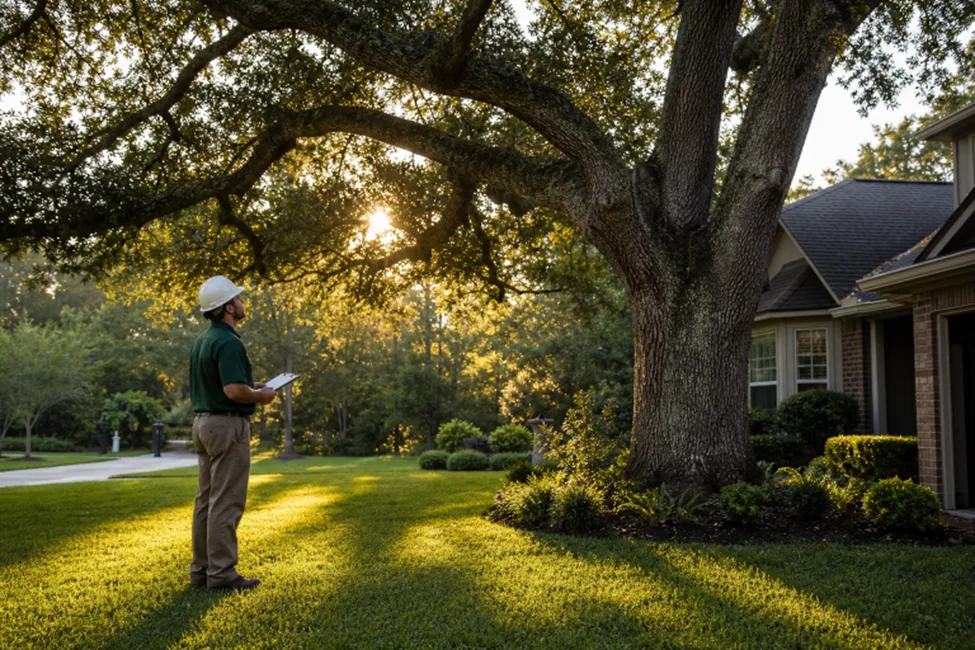
A Jacksonville yard can look exceptionally well-maintained after a lawn crew finishes mowing, edging, blowing leaves, and trimming shrubs. The grass is neat, the beds are clean, and the driveway is clear. Yet a tidy landscape is not the same thing as a healthy, structurally sound tree canopy. Homeowners who want a closer evaluation can turn to certified arborists in Jacksonville for insight that goes beyond curb appeal.
A certified arborist views a yard as a connected living system. A mature live oak beside a Southside driveway, a pine over a Mandarin roofline, or a palm near the Intracoastal may appear fine from the ground while holding warning signs in its roots, trunk, or upper canopy. Lawn maintenance is valuable, but its primary purpose is usually appearance and routine upkeep. Arborist care focuses on tree biology, structural integrity, risk, and long-term management.
Why a Clean Jacksonville Lawn Does Not Always Mean a Safe Yard
Tree concerns are often hidden in places a lawn crew may not be expected to inspect. Internal decay can weaken a trunk without changing its outward appearance. A large limb can develop a crack high above a patio. Roots may be stressed after construction, compacted by repeated vehicle traffic, or damaged by a change in drainage. These issues do not necessarily leave piles of branches or obvious messes on the lawn.
In Jacksonville, the difference matters because trees commonly grow around homes, sidewalks, pools, fences, utility areas, parked cars, and play spaces. An arborist does not simply ask whether a tree looks attractive. They also consider what could be affected if a branch or tree were to fail. This evaluation of nearby people, structures, and activity areas is central to recognizing meaningful risk.
What an Arborist Inspects First
The Tree’s Location and Potential Targets
A tree in an open corner of a large lot presents different concerns than one leaning toward a roof, screened enclosure, or neighbor’s fence. An arborist assesses the tree’s height, lean, canopy spread, and likely direction of failure, then identifies potential targets below. In established Jacksonville neighborhoods such as Riverside, Avondale, Arlington, Deerwood, and Mandarin, mature trees often share limited space with older homes, driveways, sidewalks, and overhead utilities.
This does not mean every tree near a structure is hazardous. It means location affects the urgency and type of recommendation. A dead limb over an unused wooded area may deserve monitoring, while the same limb over a front entrance or children’s play area may need prompt attention.
Species, Age, and Natural Growth Pattern
Jacksonville landscapes contain a broad mix of live oaks, laurel oaks, magnolias, pines, maples, palms, crepe myrtles, citrus trees, and ornamental species. Each grows differently and responds differently to wind, pruning, moisture, pests, and age. A professional assessment considers whether the tree’s structure is normal for its species, whether it has been improperly pruned, and whether its growth pattern suggests stress.
For example, a broad mature oak may need selective weight reduction in an overextended limb, while a pine may require close attention to dead branches, crown condition, or storm damage. A one-size-fits-all trimming approach can remove useful foliage, create weak regrowth, or leave a tree less able to handle future weather.
Soil, Drainage, and Root-Zone Conditions
The root zone can tell an arborist a great deal about a tree’s future. Jacksonville properties can have sandy soils, compacted fill, low areas that remain wet after storms, and yards altered by new patios, pools, driveways, irrigation work, or home additions. Even small grade changes can change where water collects and how much oxygen reaches the roots.
An arborist may notice exposed roots, soil heaving, fresh cracks in the ground, mulch piled against the trunk, mushrooms near the base, declining grass around compacted roots, or a tree that has begun to lean after prolonged rainfall. These signs do not confirm a diagnosis on their own, but they can indicate that further evaluation is warranted.
Hidden Root Problems a Lawn Crew May Miss
Roots anchor a tree, absorb water and nutrients, and support recovery after heat, drought, construction damage, and storms. Because most roots are below ground, their condition is easy to overlook until the tree begins to decline or move. A lawn crew may see a bare patch in the grass. An arborist may see evidence of a damaged root system, poor drainage, root decay, or soil compaction.
Warning signs can include a new or increasing lean, raised soil on one side of the trunk, broken surface roots, unexplained canopy thinning, dieback at branch tips, or fungal growth around the root flare. The root flare is the slightly widened area where the trunk meets the roots. It should not be buried under excessive soil or mulch.
Root decay can be especially difficult to identify from a casual visual check. The University of Florida’s guidance on assessing hurricane-damaged trees notes that decay may exist without obvious external symptoms and that fungus at the base of the trunk can indicate root rot. A qualified inspection can help determine whether a tree should be monitored, pruned, supported, treated, or removed.
What the Trunk and Branch Unions Reveal
Trunks and major branch connections carry the weight of the canopy. They are also common locations for defects that develop slowly over the years. An arborist looks for vertical cracks, seams, cavities, old wounds, loose bark, unusual swelling, dead bark, and decay around former pruning cuts. Some conditions are cosmetic or manageable. Others can signal a weakening structure.
Branch unions deserve particular attention. A strong union generally has overlapping wood that securely connects the branch and trunk. A weak union may have a tight V-shaped attachment or include bark, which is bark trapped between two stems. Inclusions in bark can prevent the stems from forming a strong connection, increasing the chance of splitting as they grow larger and heavier.
In a Jacksonville yard, this may show up as two competing trunks above a driveway, a large limb extending over a roof, or a heavy branch that catches strong summer wind. A certified arborist considers the size of the limb, the defect, the tree’s overall condition, its exposure to wind, and what lies beneath it. The right answer may be targeted pruning, a support system, regular monitoring, or removal of a clearly unsafe section.
Jacksonville Weather Changes the Tree Care Conversation
Jacksonville trees endure conditions that can shift quickly across a year. Summer thunderstorms can bring powerful gusts and saturated soil. Tropical weather can place sustained pressure on limbs and root systems. Extended hot periods can stress trees that already have limited rooting space or poor irrigation patterns. Coastal and beach communities may also experience salt spray and saltwater flooding during severe weather.
That local context is why cosmetic trimming is not enough for many properties. Thoughtful pruning can reduce deadwood and improve clearance, but it should also preserve enough healthy canopy for the tree to produce energy and remain resilient. The City of Jacksonville’s urban forestry program identifies tree canopy as important for reducing heat, managing stormwater runoff, improving air quality, and supporting wildlife habitat. Healthy trees are a community asset, but they require proper stewardship.
How Professional Pruning Differs From Cutting Back Overgrowth
Professional pruning begins with a purpose. That purpose may be removing dead or broken branches, improving clearance from a roof or driveway, reducing the load on a long, heavy limb, correcting a developing structural issue, or improving airflow through a dense canopy. It is not simply a matter of making every branch shorter.
Improper cuts can leave large wounds, encourage weak sprouts, remove too much foliage, and make a tree more vulnerable to stress. Excessive thinning, sometimes called over-pruning, can also expose interior limbs and bark to more sun and wind. A trained arborist makes cuts with the tree’s natural structure, health, and future growth in mind.
When Cabling, Bracing, or Removal May Be Considered
Tree care is not always a choice between doing nothing and taking down the whole tree. Depending on the tree’s condition and location, an arborist may recommend one or more of the following:
- Selective pruning: Removing deadwood, reducing weight on an overextended branch, or improving clearance.
- Cabling or bracing: Providing supplemental support for a weak branch union, split trunk, or heavy limb when the tree is otherwise worth preserving.
- Tree health care: Addressing likely insect, disease, soil, moisture, or nutrition concerns when a diagnosis supports treatment.
- Monitoring: Rechecking a defect that is not currently severe enough to justify immediate work.
- Removal: Eliminating a tree with severe decay, major root failure, an unstable lean, extensive storm damage, or unacceptable risk to people and property.
Support systems are not guarantees that a tree can never fail. They are tools that may reduce movement and stress when used as part of a well-considered management plan. Likewise, removal should be based on a professional assessment of the tree, its defects, and the consequences of failure, not fear alone.
Early Tree Health Clues Matter
Many tree problems begin quietly. An arborist may notice thinning foliage, abnormal leaf color, sparse growth on one side of the canopy, unusually small leaves, new deadwood, pest activity, cankers, or a change in the tree’s seasonal appearance. These symptoms can be related to drought, poor drainage, insects, fungal disease, compacted soil, root injury, age, or previous pruning practices.
Early evaluation gives homeowners more choices. A tree may benefit from changes in watering practices, mulching, pruning, soil management, or continued observation. No responsible tree professional can promise that every declining tree can be saved, but delaying attention until large limbs begin to fail often reduces the available options.
When Jacksonville Homeowners Should Request an Inspection
Consider scheduling a professional tree evaluation after a major storm, before hurricane season, after nearby construction, or whenever a tree shows a noticeable change. Specific signs to take seriously include:
- New cracks, splits, cavities, or missing bark on the trunk.
- Large dead, broken, hanging, or rubbing branches.
- Mushrooms or fungal growth at the base of the tree.
- A lean that appears new or is becoming more pronounced.
- Roots that have been cut, exposed, covered, compacted, or damaged.
- Branches growing over roofs, entrances, vehicles, utility lines, or play areas.
- Sudden canopy thinning or unexplained dieback.
Homeowners should not climb, cut, or attempt to pull down hazardous limbs themselves. Trees can hold enormous weight, and damaged wood can react unpredictably. Work near power lines requires specialized training and coordination with the appropriate utility provider.
A Practical Next Step for Tree Care in Jacksonville
Before requesting service, take ground-level photos of the full tree and any visible concerns. Note recent storms, standing water, construction activity, changes in irrigation, or the timing of canopy decline. Ask whether the evaluation will consider roots, trunk condition, branch structure, nearby targets, and site conditions. A clear written proposal should distinguish urgent work from recommended maintenance or optional monitoring.
Location: Bushor’s Tree Surgeons | 5525 St Augustine Rd, Jacksonville, FL 32207 | (904) 789-8884
Bushor’s Tree Surgeons can help Jacksonville property owners move beyond surface-level yard maintenance and make informed decisions about tree trimming, health care, structural support, removal, storm cleanup, and risk concerns.
A lawn crew helps keep a yard presentable. A certified arborist looks more closely at the living structures that shade Jacksonville homes, manage rainfall, define neighborhoods, and sometimes pose hidden risks. Addressing warning signs early can protect property, preserve valuable trees when possible, and make a yard more resilient before the next round of Florida weather arrives.