You’ve done the research, watched the videos, and decided a chamber vacuum sealer is the right tool for your kitchen. But then comes the practical question that most buying guides skip right over: will it actually fit on your counter? These machines are not like their handheld cousins. They’re built differently, they sit differently, and they take up real estate. Before you place an order, it’s worth understanding exactly what sizes are out there and how to figure out which one belongs in your space.
Why Chamber Vacuum Sealer Size Matters More Than You Think
A chamber vacuum sealer works by placing the entire bag inside a sealed chamber, pulling out all the air, and then heat-sealing the bag before releasing the pressure. That process requires a rigid, well-built body, which is why these machines tend to be heavier and bulkier than edge sealers. The size of the unit directly affects what you can seal, how much counter space it occupies, and whether you’ll actually use it regularly or push it to the back of a cabinet.
For home cooks who do batch meal prep, sous vide cooking, or long-term food storage, a chamber vacuum sealer becomes a frequent-use appliance. That means placement matters just as much as performance. A machine that’s too large will crowd your workspace and create frustration every time you need it. On the other hand, a model that’s too small may not fit the bags or pouches you need for larger cuts of meat or big batch soups.
The chamber vacuum sealer category spans a wide range of footprints, from compact countertop units designed for home use to full commercial-grade machines. Knowing where your needs fall on that spectrum is the first step toward finding a size that actually works for your kitchen.
Standard Dimensions of Home and Compact Chamber Vacuum Sealers
Compact Models: The Best Fit for Most Home Kitchens
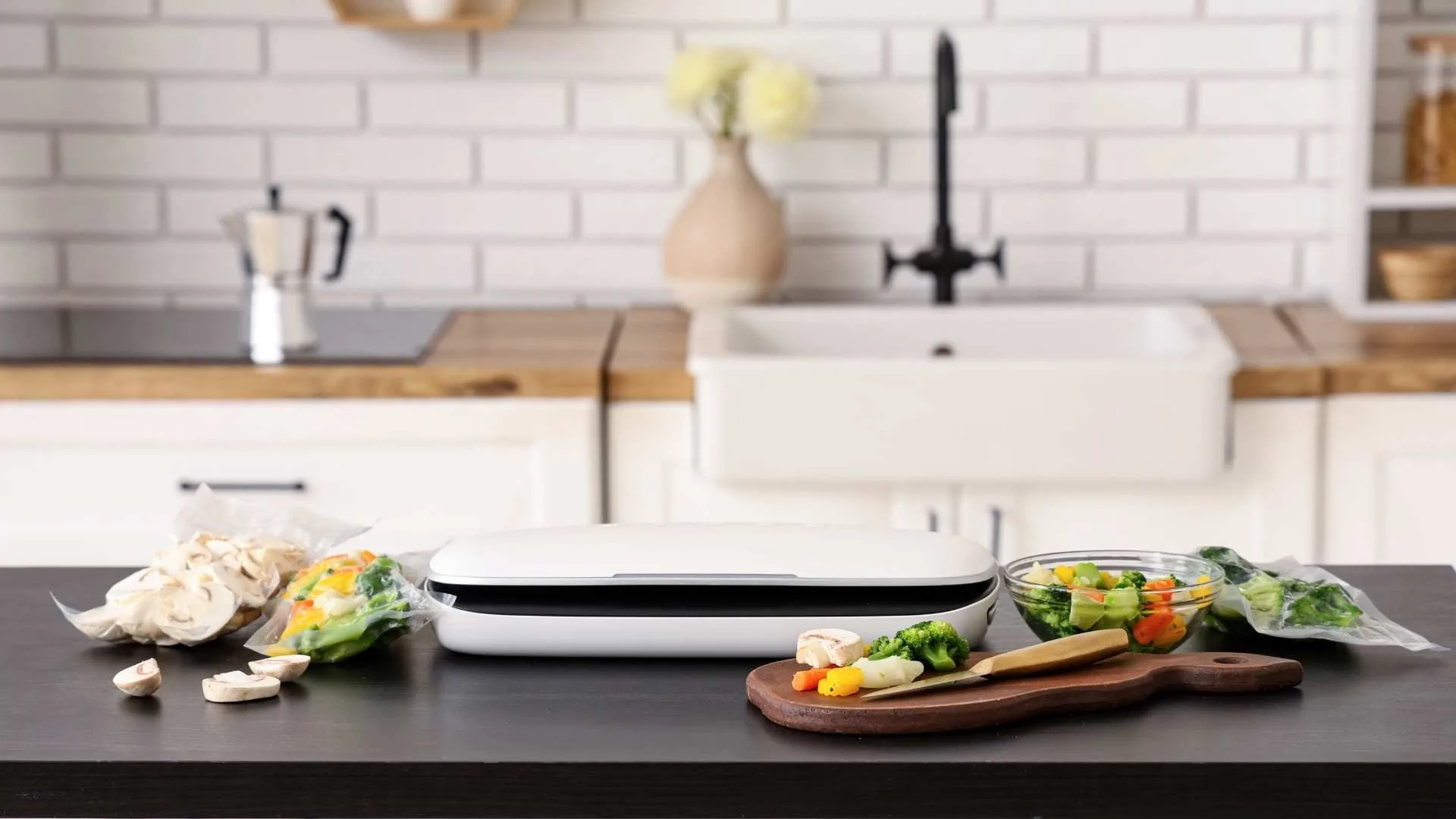
Compact chamber vacuum sealers are typically designed with the home cook in mind. These units generally measure between 12 and 15 inches wide, 12 to 14 inches deep, and 10 to 13 inches tall. Their weight usually falls in the range of 20 to 35 pounds, which is manageable but still substantial enough to stay put on the counter during operation.
These smaller models are the ones that fit comfortably on a standard kitchen counter, which in most homes runs about 24 to 25 inches deep and sits 36 inches from the floor. With that in mind, a compact unit at 13 inches deep leaves you with over 10 inches of usable space in front of it, which is enough room to work comfortably. The chamber size in these models is typically sufficient for quart-size bags and standard vacuum pouches up to about 8 to 10 inches wide.
For most households, a compact model covers every real-world use case. Portioning chicken breasts, sealing marinated vegetables, preserving leftovers, or preparing sous vide bags all fall well within what a compact unit handles without difficulty.
Mid-Size and Full-Size Models: When You Need More Capacity
Mid-size chamber vacuum sealers push into the 16 to 20 inch width range, with depths that can reach 18 inches or more. Full-size commercial units can exceed 20 inches in width and weigh upward of 60 to 80 pounds. These are built for high-volume use and are often found in restaurants or small food production operations.
For a home kitchen with a standard 24-inch deep counter, a mid-size unit can still work, but it will dominate the space. You’ll need to think carefully about what else you need nearby. Full-size models, by contrast, are generally not practical for home counter placement. Most home users who need that level of capacity choose to set them on a dedicated cart or table rather than a standard counter.
If you regularly seal gallon-size bags, large roasts, or full fish fillets, a mid-size model gives you the chamber width to do so without compromise. But, for most households, the added size rarely translates into proportionally better results.
How to Measure Your Counter Space Before You Buy
Measuring your counter before purchasing a chamber vacuum sealer is a step that saves real headaches. Start with the depth of your counter surface. Most standard counters run 24 to 25 inches deep, but if your counter sits beneath upper cabinets, the usable vertical height above it becomes just as important as the horizontal footprint.
Measure the clearance from your countertop to the bottom of any overhead cabinets. Many compact chamber sealers have lids that open upward, and you’ll need enough vertical space to lift the lid fully without it hitting the cabinet above. A typical compact unit requires about 18 to 22 inches of total vertical clearance once the lid is open. If your cabinets sit at the standard height of 18 inches above the counter, you may find the lid won’t open fully, or you’ll need to pull the machine forward before each use.
Also, measure the width of the area you plan to use. Note any outlets, edges, or adjacent appliances that could limit placement. A machine that measures 14 inches wide needs at least 14 inches of unobstructed horizontal space, and ideally a bit more so you can access the controls and load bags without awkward maneuvering. Write these numbers down before you start comparing models.
Countertop Clearance, Weight, and Storage Considerations
Beyond the footprint itself, three practical factors often get overlooked: lid clearance, machine weight, and whether you plan to store the unit between uses.
Lid clearance is the detail that catches most buyers off guard. Unlike edge sealers that sit flat, a chamber vacuum sealer has a hinged lid that opens upward at an angle. That requires overhead clearance you may not have if the machine sits directly under wall cabinets. If you find that clearance is tight, consider placing the unit on a lower surface, a kitchen island, or a rolling cart that you can pull away from the wall.
Weight is another practical reality. A compact home model at 25 to 35 pounds isn’t something you’ll want to move every day. If you plan to store it in a lower cabinet and bring it out for use, consider whether you can safely lift and carry it repeatedly. Many home cooks find that the friction involved in storing and retrieving a heavy machine means it stops being used regularly. In that case, finding a permanent counter spot is the smarter approach.
Finally, if permanent counter placement isn’t possible, look for models with a lower profile and a lid that doesn’t require full overhead clearance. Some newer compact designs have a lower chamber height and side-access lids that reduce the vertical clearance needed. These features don’t reduce performance, but they do make the machine far easier to place and use in a real home kitchen.
Conclusion
For most home kitchens, a compact chamber vacuum sealer in the 12 to 15 inch width range is the right fit. It handles everyday tasks without overwhelming your counter space. Before you buy, measure your depth, width, and overhead clearance carefully, and factor in weight if storage is part of your plan. The right size isn’t just about specs on a product page. It’s about what actually works in your kitchen every single day.