When small business owners talk about workers’ compensation, they usually focus on Part A—the state-mandated coverage that pays for an injured employee’s emergency room visits, physical therapy, and lost pay. But there’s a critical second half to every policy that often gets overlooked until a summons arrives: Part B, or Employer’s Liability.
While Part A covers no-fault statutory benefits, Part B protects your business if an injured worker (or their family) sues you for civil negligence, claiming your gross carelessness caused their injury. Standard plans have the basic coverages of $100,000 for accidents, $500,000 coverage per disease, and $100,000 coverage for each employee for disease ($100k/$500k/$100k). Yet, working with workers comp insurance in georgia or anywhere else means that you must decide if the basic coverages put your business at risk or if $1,000,000 coverages ($1M/$1M/$1M) is the smarter play.
Here are five key factors to help you pick the right limit for your operation.
- Contractual Mandates and Client Bidding Requirements
If you operate as a subcontractor or bid on commercial projects, the decision might already be made for you. General contractors, project developers, and government agencies increasingly demand $1,000,000 in Employer’s Liability limits before allowing anyone on site.
Carrying only $100,000 can immediately disqualify your company from lucrative proposals. Even if a contract doesn’t explicitly require $1M limits on day one, holding higher policy limits makes your business far more attractive to corporate risk managers who want to ensure everyone on the job site is adequately protected.
- High-Risk Operations vs. Low-Hazard Classifications
Your industry’s physical risk profile should directly dictate your liability limits. A boutique digital marketing agency with five employees working at desks faces a drastically lower probability of a catastrophic liability suit than a roofing contractor or a heavy equipment operator.
Consider the worst-case scenario for your line of work:
- Low Risk (Office and Retail): Simple slip and fall cases or repetitive injury cases that do not normally give rise to any litigation.
- High Risk (Construction, Manufacturing, Fleet): Cases of traumatic brain injury, amputation, and other cases of serious injury that result in claims that exceed the statutory amount.
If a severe workplace incident occurs in a high-hazard environment, injured employees or their families are significantly more likely to hire legal representation to seek damages beyond basic medical coverage.
- Third-Party Over Lawsuits and Uncovered Exposures
Many employers assume that workers’ comp prevents employees from ever suing them. That isn’t entirely true. A common loophole is a Third-Party Over Action.
For instance, if your employee is injured by a piece of machinery on a job site, they might sue the machine manufacturer. That manufacturer can then turn around and sue you, claiming you failed to maintain the machine or train the worker properly.
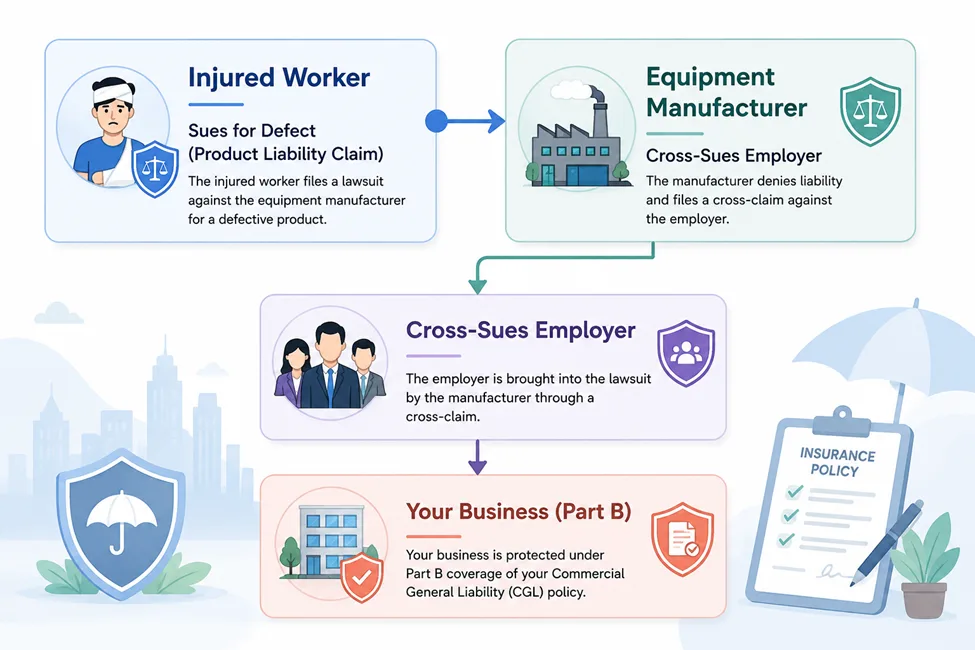
When setting up workers comp insurance in georgia, businesses with three or more employees must meet basic state mandates, but relying solely on minimum statutory thresholds leaves you vulnerable to these complex cross-suits. Securing robust coverage tailored to your state’s operating climate ensures that third-party claims won’t bankrupt your business.
- Commercial Umbrella Policy Requirements
If your business carries a Commercial Umbrella or Excess Liability policy to extend protection across your general liability and commercial auto lines, pay close attention to your underlying policy rules.
Most commercial umbrella carriers will not sit on top of a $100,000 Employer’s Liability limit. They typically mandate an underlying Part B limit of at least $500,000 or $1,000,000. If you keep $100K limits on your primary workers’ comp policy, your umbrella policy won’t cover an excess employer liability claim, creating a dangerous coverage gap.
The silver lining? Upgrading your Part B limits from $100K to $1M usually costs an extra $50 to $150 per year on your premium.
- Defense Costs and Settlement Inflation
Legal representation is expensive. Defending against an employer liability lawsuit involves corporate attorneys, expert safety witnesses, workplace reconstructions, and court fees.
In many policy structures, legal defense costs can erode your policy limit or quickly drain a standard $100,000 allowance before a case even reaches a settlement or verdict. If a court awards $300,000 in damages and your limit is capped at $100,000, your business is directly on the hook for the remaining $200,000 balance out of pocket.
Quick Comparison: $100K vs. $1M Employer’s Liability
| Coverage Feature | $100K / $500K / $100K Limit | $1M / $1M / $1M Limit |
| Primary Target | Micro-businesses, sole offices | Contractors, high-risk trades, growing teams |
| GC Contract Acceptance | Low (Often rejected on commercial sites) | High (Meets standard master service agreements) |
| Umbrella Policy Fit | Rarely compatible | Fully compliant with most umbrella carriers |
| Relative Cost Impact | Base policy cost | Nominal (+1% to +3% premium bump) |
The Verdict
If you operate a low-risk, small-scale business with no contractual mandates or umbrella policies, the standard $100K limit might satisfy your immediate requirements. However, for growing companies, contractors, or businesses operating in physical trades, upgrading to $1,000,000 in Employer’s Liability provides vital balance-sheet protection for just a few extra dollars a month. Review your active contracts, talk with your insurance advisor, and make sure your policy matches your real-world legal risk.