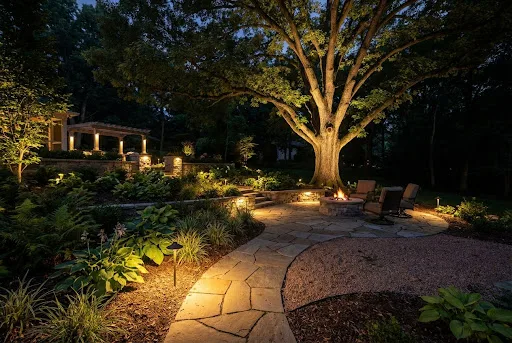
Truly beautiful homes do not stop at the back door, and outdoor focal points often shape a guest’s first emotional impression just as much as an entry hall. Applying these estate landscaping features transforms a basic lawn into an intentional, cohesive extension of your home’s interior character.
Studies show that a well-designed outdoor space can significantly boost property appeal, contributing to a perceived value increase of five to twelve percent for single-family homes. By focusing on strategic lighting, structured spaces, and natural movement, property owners can achieve a luxury aesthetic without the disruption of a complete landscape overhaul.
1. Illuminated Water Elements
The sensory combination of moving water and soft illumination is one of the most powerful outdoor design tools available. Movement naturally draws the eye, and light amplifies that dynamic motion.
Together, they create an organic focal point that no static garden bed or sculpture can fully replicate. It is precisely this quality that gives estate landscapes their unmistakable after-dark presence, establishing a scene that feels entirely unhurried.
From a design standpoint, placement matters as much as the feature itself. A fountain positioned near a primary seating area or within sightline of a key window becomes a living centerpiece. After dark, warm light blooming beneath the surface creates a shifting theater of reflected movement.
For larger setups, options ranging from custom-carved basalt bubblers and pond fountains with RGB lights from Everblue Pond to integrated sheer descents illustrate how lighting elevates the space. Warm, diffused light beneath the spray pattern and a scale appropriate to the surrounding space are essential characteristics of a successful illuminated pond design.
When guests gather at dusk, the conversation is softened by the sound of water. The fountain’s warm glow ripples outward across the patio, cementing the overall atmosphere. That specific ambiance remains one of the defining signatures of a truly considered outdoor space.
| Key Insight: Lighting and water create a dynamic focal point that static garden elements cannot match. By adding underwater illumination, you extend the visual enjoyment of your landscape well into the evening hours. |
2. Layered Landscape Lighting
Single-source outdoor lighting is the visual equivalent of one bare overhead bulb in a dining room. It may technically illuminate the space, but it does nothing to create an inviting atmosphere. Flat, uniform brightness washes out depth and makes even a beautifully designed yard feel purely utilitarian after dark.
Layering multiple light sources is the specific solution consistently used in high-end design. This strategy involves combining at least two or three distinct lighting levels to shape the nighttime environment. Path lighting at ground level guides movement and defines edges clearly.
Uplighting aimed at trees or architectural elements adds dramatic height, while accent lighting softly highlights garden borders. Each layer contributes something unique that the other options cannot accomplish alone. The defining design principle is that the ultimate goal is not brightness, but rather contrast and warmth.
Shadows are just as important as illumination, signaling deliberate design in a way that flat brightness never can. Starting with two or three well-placed uplights and a clearly defined pathway line completely shifts the visual character of the space. This foundational approach allows additional lighting layers to be added gradually over time.
3. Defined Entertaining Zones
An undefined yard is one of the most common and easily correctable outdoor design mistakes. When outdoor space is broken into purposeful zones, such as a dining area or a fire pit gathering spot, the entire property reads as intentionally designed.
Zones create vital visual anchors that tell guests exactly where to gather. A defined seating area grouped around a subtle boundary makes a yard feel larger and more richly considered.
Natural materials are the key to making these boundaries feel organic rather than rigid or forced. Stone, weathered timber, and native plantings create soft borders that do the structural work of defining space beautifully.
These curb appeal upgrades deliver a high return on investment because they fundamentally change how the property is experienced. In fact, research indicates that every dollar invested in a residential landscape yields a $1.35 return.
A fire pit zone visible from the kitchen window builds a cohesive indoor-outdoor aesthetic grounded in clear intention. Lanterns anchoring an outdoor dining table further reinforce this structured, organized approach. The yard simply looks as though it naturally grew into these distinct, usable spaces. Implementing these zones creates a lasting impression of abundance and luxury backyard ideas.
| Pro Tip: Use varying textures like gravel, wood, or stone to distinguish separate entertaining areas. These subtle material shifts create clear “outdoor rooms,” making your property feel significantly larger and more professionally designed. |
4. Architectural Pathways or Bridge Details
A pathway is rarely just practical when integrated into well-designed outdoor spaces. The route through the yard becomes part of the experience itself, guiding movement and building anticipation. It adds layers of texture and character to the landscape that no amount of planting alone can achieve. Stone pavers, flagstone paths, and timber bridges effortlessly introduce architecture into a natural setting.
These pathways connect areas of the yard with a visual language that echoes the home’s own character. Formal symmetry can be established with clean-cut bluestone, while a relaxed vibe comes from a meandering flagstone path.
This attention to detail reflects the broader environment, much like how homes adjacent to parks are valued significantly higher than comparable properties. The pathway acts as a definitive design statement rather than just a utilitarian surface to walk on. Material choice is where this specific upgrade truly earns its luxury credentials. Natural stone reads as considered and permanent without requiring overly complex installation.
A small arched timber bridge over even a shallow planting strip instantly elevates the surrounding landscape. These architectural details signal to guests that every part of the property has been thoughtfully considered.
The Bottom Line
The most successful exterior upgrades balance beauty, atmosphere, and real function flawlessly. Each element does quiet, consistent work every time someone arrives at the home or steps outside after dark. None of these four upgrades requires a full landscape renovation to be highly effective. Furthermore, they certainly do not need to be implemented all at once to make an impact.
The most useful approach is identifying which concept speaks naturally to how the outdoor space is already utilized. If evenings outside are a priority, start with illuminated water features or layered landscape lighting.
For those who entertain regularly, defined zones will immediately change how outdoor gatherings feel. One well-executed feature that genuinely reflects the home’s personality will always make a stronger statement than a dozen unrelated additions.
| Author Profile: Everblue Pond offers a broad selection of large pond, commercial lake, and water-feature equipment for landowners, farmers, acreage owners, ranch owners, large property owners, golf course managers, pond managers, and property managers who want cleaner water, healthier ecosystems, and dependable year-round operation. |