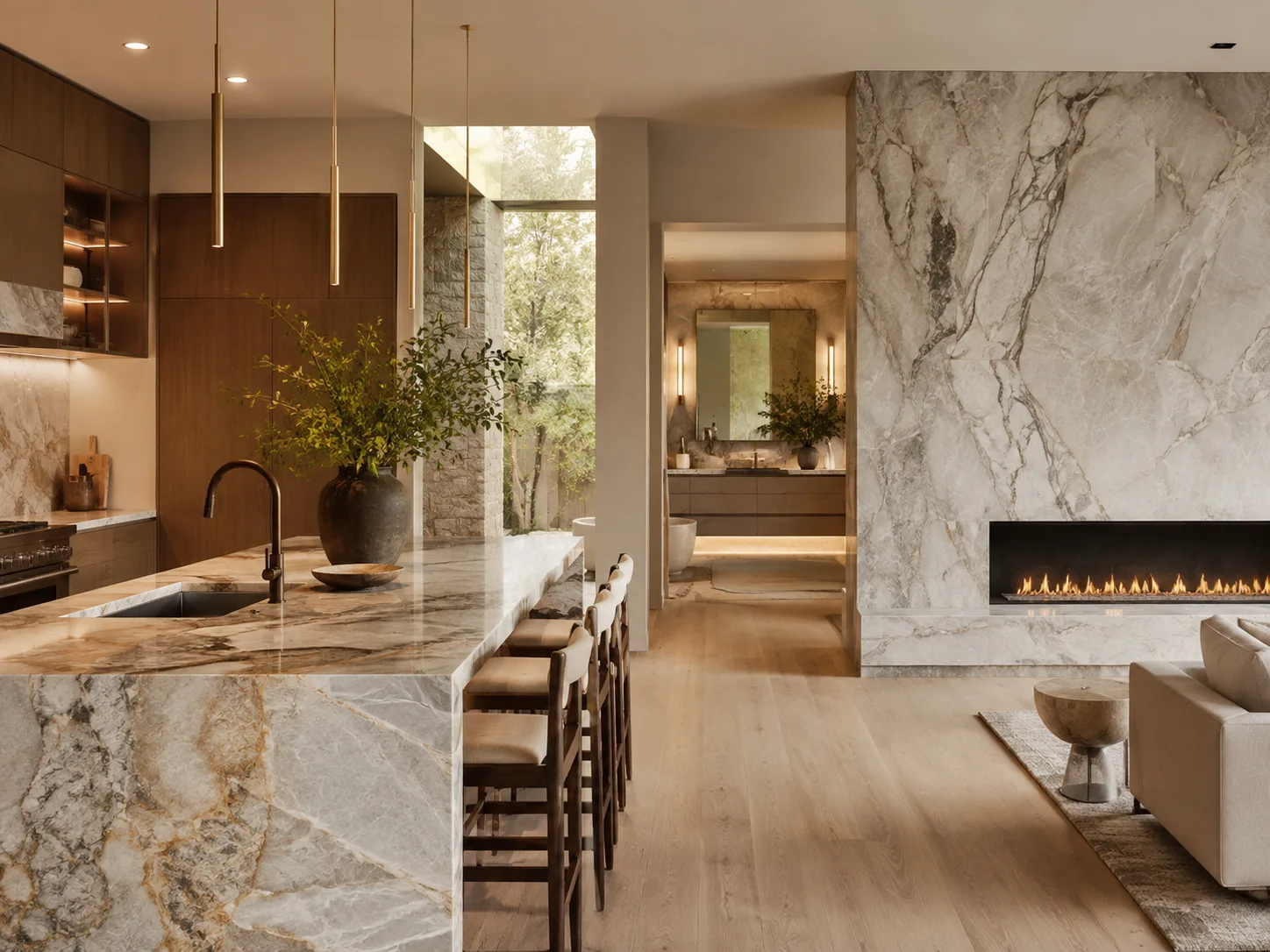
Natural stone has a rare ability to make an interior feel more permanent, individual, and connected to architecture.
Unlike decorative finishes that may rely heavily on short-term trends, marble, quartzite, travertine, granite, and other natural stones can become part of the structure and visual identity of a home. A single slab may contain veins, mineral movement, crystalline details, and color transitions that make the finished surface impossible to reproduce exactly.
That individuality is one reason natural stone continues to appear in luxury kitchens, spa-inspired bathrooms, fireplaces, feature walls, custom furniture, and high-end residential renovations.
But using stone successfully is not simply about choosing the most dramatic slab.
The best results come from understanding where stone should become the focal point, where it should remain quiet, and how the material interacts with cabinetry, lighting, timber, metal, furniture, and everyday use.
A dramatic kitchen island may need a calm backsplash.
A marble bathroom wall may need simple cabinetry.
A bookmatched fireplace may need very little artwork around it.
Luxury is created through balance.
This guide explores practical ways to use natural stone across kitchens, bathrooms, and feature walls while avoiding the mistakes that can make even an expensive material feel poorly considered.
Why Natural Stone Works So Well in Luxury Interiors
Natural stone brings several qualities together.
Individuality
Every natural slab is different.
Variations can appear in:
- vein direction;
- mineral concentration;
- background color;
- crystalline areas;
- tonal movement;
- natural markings.
This means a stone installation can give a home an identity that is difficult to duplicate.
Scale
Large slabs allow designers to create broad uninterrupted surfaces.
This works particularly well for:
- kitchen islands;
- fireplace walls;
- showers;
- bathroom vanities;
- full-height backsplashes.
The larger the visible stone surface, the more important the slab pattern becomes.
Material Depth
Natural stone often changes under different lighting.
A slab may appear relatively calm during the day and reveal warmer mineral details under evening lighting.
This gives the surface greater visual depth than a flat decorative finish.
Longevity
Good stone selection is less dependent on one short-lived design trend.
Cabinet colors or furniture styles may change, while a thoughtfully chosen natural material can continue working with several generations of interior design.
Start With the Application Before Choosing the Stone
The first mistake many homeowners make is choosing a slab before deciding how the surface will be used.
Instead, begin with the application.
Ask:
- Is the surface decorative or functional?
- How frequently will it be touched or used?
- Will it be exposed to food or water?
- How much maintenance is realistic?
- Should the stone become a focal point?
- How large is the installation?
This immediately changes the selection process.
A fireplace feature wall and a kitchen countertop do not need to satisfy the same requirements.
A bathroom wall and a wet floor also need different considerations.
The correct material depends on the job.
Luxury Kitchens: Let the Island Lead the Design
The kitchen island is one of the strongest places to use natural stone.
In modern open-plan homes, the island may be visible from several spaces at once.
It can function as:
- preparation surface;
- dining area;
- social space;
- architectural divider;
- visual focal point.
This makes the island closer to a permanent piece of architectural furniture than a simple countertop.
If the kitchen uses relatively restrained cabinetry, a dramatic slab can become the main design element.
Use Quartzite for a Strong Natural Focal Point
Quartzite can be particularly effective in kitchens where homeowners want natural geological movement together with a material suitable for substantial countertop applications.
Depending on the stone, the slab may contain:
- grey movement;
- green or blue mineral areas;
- gold veins;
- crystalline details;
- dark contrast;
- warm cream backgrounds.
A carefully selected exotic quartzite surface can work especially well on oversized islands, waterfall countertops, full-height backsplashes, bars, and other high-visibility areas where the stone is expected to become part of the room’s identity.
If the Quartzite Is Highly Dramatic
Keep surrounding materials quieter.
A strong combination might be:
dramatic quartzite + walnut + warm neutral flooring
or:
green quartzite + white oak + cream walls
The objective is to give the stone enough space to be appreciated.
Use Waterfall Edges Selectively
Waterfall countertops continue the stone vertically down the side of the island.
This can create a substantial architectural effect.
However, a waterfall should not be added automatically.
For strongly directional stone, the fabricator needs to consider:
- vein continuation;
- corner alignment;
- usable slab size;
- waste;
- joint position.
If the pattern cannot connect successfully, a conventional edge may look more sophisticated.
If the Vein Can Continue Naturally
→ Consider the waterfall.
If the Pattern Becomes Disconnected
→ Keep the stone on the horizontal surface.
More stone is not always better stone design.
Full-Height Backsplashes Can Simplify the Kitchen
Traditional backsplashes often use smaller tiles.
Luxury kitchens increasingly use large slab surfaces instead.
A full-height stone backsplash can:
- reduce grout lines;
- create visual continuity;
- make the kitchen feel cleaner;
- display the natural pattern at a larger scale.
But the backsplash and island should not always compete.
If the Island Is Dramatic
Choose a quieter backsplash.
If the Island Is Restrained
The backsplash can become more expressive.
One visual focal point is usually stronger than two surfaces fighting for attention.
Match Stone With Cabinetry
Cabinet color affects how stone appears.
White or Cream Cabinets
Can support both subtle and dramatic stones.
Use stronger veining if you want contrast.
Use softer stone if the goal is calm elegance.
Light Oak
Pairs naturally with:
- white stone;
- cream quartzite;
- grey marble;
- green stone.
Walnut
Works particularly well with:
- warm white stone;
- gold mineral movement;
- green quartzite;
- beige surfaces.
Dark Cabinets
Lighter stone can prevent the kitchen from becoming visually heavy.
Dark-on-dark interiors can still work, but lighting becomes much more important.
Bathroom Design: Create a Spa-Like Material Experience
Bathrooms offer a very different opportunity.
The goal is often less about creating one dramatic countertop and more about creating visual calm.
Luxury hotel bathrooms are a useful reference.
Many successful bathrooms reduce the number of visible materials and increase the scale of individual surfaces.
Instead of five different tiles, designers might use:
- one main stone;
- one timber tone;
- one metal finish;
- neutral walls.
This creates a more coherent atmosphere.
Use Large Stone Surfaces to Reduce Visual Clutter
Large-format stone panels can work particularly well:
- behind a vanity;
- around a bathtub;
- inside a large shower;
- across a feature wall.
Fewer joints can make the room feel more continuous.
This is particularly effective in smaller luxury bathrooms.
Too many small patterns can make compact spaces feel visually fragmented.
Marble Works Beautifully in Bathrooms
Bathrooms are one of the most natural residential settings for marble.
Marble can provide:
- soft natural movement;
- elegant color;
- a tactile surface;
- strong visual association with luxury interiors.
A full-height marble vanity wall can become the main feature of the bathroom.
A lighter marble can create a calm spa atmosphere.
A dark or green marble can create a more dramatic powder room.
Choose Marble According to the Mood
A single material category can create very different interiors.
White and Grey Marble
Best suited to:
- minimal bathrooms;
- contemporary spaces;
- bright interiors.
Beige or Warm Marble
Works well in:
- resort-style bathrooms;
- warm contemporary homes;
- Mediterranean-inspired interiors.
Dark Marble
Can create stronger drama in:
- powder rooms;
- vanity walls;
- feature niches.
Green Marble
Pairs beautifully with:
- walnut;
- bronze;
- brass;
- warm neutral textiles.
The strongest choice depends on the surrounding palette.
Understand Marble Maintenance
Marble is a natural material and should not be expected to behave like a completely maintenance-free manufactured surface.
Appropriate cleaning matters.
Depending on the material and application, sealing may also be recommended.
Most importantly, homeowners should understand that natural stone can develop signs of use.
If You Appreciate Patina
Marble can remain extremely rewarding over time.
If Every Minor Surface Change Causes Concern
Consider whether the application should use a different material.
The best material is the one that matches real expectations.
Think About Wet Areas Separately
A material that works beautifully on a wall does not automatically make the best wet floor.
Bathrooms need to consider:
- slip resistance;
- finish;
- drainage;
- waterproofing;
- cleaning;
- grout or joints.
A polished stone wall may be appropriate while the floor requires a less reflective or more textured finish.
Safety and appearance need to work together.
Feature Walls: Let Stone Replace Decoration
Feature walls are one of the most powerful ways to use natural stone without covering an entire home.
Potential locations include:
- fireplaces;
- living rooms;
- dining rooms;
- entrances;
- bedrooms;
- stair halls.
A large stone wall can perform the role of artwork.
This allows the rest of the room to remain visually quieter.
Marble Creates Timeless Feature Walls
Marble works particularly well when the room needs a focal point that feels elegant rather than overly trend-driven.
Large premium marble slabs can be used across fireplace walls, entrance features, bathroom walls, dining areas, and other architectural surfaces where natural veining is intended to become part of the composition.
For stronger patterns, slab layout becomes extremely important.
The question is no longer simply:
“Which marble do I like?”
It becomes:
“How will these veins appear when the slabs are installed together?”
That is a very different design decision.
Bookmatching Can Turn Stone Into Art
Bookmatching arranges adjoining slabs so that their patterns mirror one another.
This creates a symmetrical composition.
It can work particularly well for:
- fireplace walls;
- foyers;
- bathrooms;
- dining spaces.
The technique is most effective when the stone has strong directional movement.
Before fabrication, designers should confirm:
- slab sequence;
- center line;
- wall dimensions;
- joint position;
- lighting;
- furniture.
A dramatic bookmatch should align with the architecture.
If the wall contains a fireplace, the center of the stone composition may need to align with the fireplace opening.
If a large television is installed, the design needs to account for how much of the slab will remain visible.
Do Not Hide the Best Part of the Stone
This is an surprisingly common mistake.
Homeowners select an extraordinary slab.
Then:
- a mirror covers the strongest vein;
- a television hides the center;
- a sink removes the best mineral section;
- cabinetry covers half the pattern.
The solution is simple:
Plan the stone and fixtures together.
For highly expressive slabs, create a layout before fabrication.
Identify which part should remain visible.
Stone placement should be intentional.
Fireplace Walls Are Ideal Statement Locations
A fireplace provides a natural visual center.
Floor-to-ceiling stone can make it feel more architectural.
Potential directions include:
Calm Fireplace
Use subtle marble or neutral stone.
Pair with:
- light timber;
- soft furniture;
- simple lighting.
Dramatic Fireplace
Use stronger marble or quartzite.
Keep artwork and furniture restrained.
Bookmatched Fireplace
Use slabs with strong directional movement.
Center the composition on the fireplace.
Use Stone and Wood Together
Stone can feel cold when surrounded only by other hard materials.
Wood changes that immediately.
Natural timber introduces:
- warmth;
- grain;
- softness;
- visual contrast.
Popular combinations include:
white marble + walnut
cream quartzite + oak
green stone + dark timber
travertine + light oak
These combinations work because the materials provide different types of natural texture.
Add Textiles for Softness
Living spaces with stone feature walls benefit from textiles.
Consider:
- wool rugs;
- linen curtains;
- upholstered seating;
- textured cushions.
Hard and soft materials need each other.
A room made entirely from stone, glass, and metal may look impressive but can feel uncomfortable.
Lighting Changes the Stone More Than Most People Expect
A slab should not be selected without considering the room’s lighting.
Natural daylight may reveal:
- cooler grey;
- blue;
- subtle mineral areas.
Warm artificial lighting may strengthen:
- cream;
- beige;
- brown;
- gold.
This can make a significant difference.
A stone selected under warehouse lighting may look warmer or cooler after installation.
Whenever possible, evaluate samples with:
- cabinet material;
- flooring;
- wall color;
- lighting temperature.
Consider Polished vs Honed Finishes
Finish changes the atmosphere.
Polished
Provides greater reflectivity and usually stronger color depth.
Useful when:
- formal luxury is desired;
- the stone has attractive mineral movement;
- reflection suits the room.
Honed
Provides a softer appearance.
It can work well with:
- timber;
- plaster;
- matte metals;
- contemporary interiors.
Neither finish is automatically better.
Choose according to the application and design.
One Stone Does Not Need to Cover the Whole Home
Consistency does not mean repetition.
A luxury home can use several stones if they share a material language.
For example:
Kitchen → expressive quartzite
Bathroom → light marble
Living room → warmer neutral stone
What connects the spaces might be:
- shared warm undertones;
- similar metal finishes;
- consistent timber;
- related stone finishes.
The home feels coordinated without looking copied room to room.
Common Mistakes When Designing With Natural Stone
1. Choosing Only From a Small Sample
Large slabs contain patterns that small samples cannot show.
Review full slabs whenever possible.
2. Using the Most Dramatic Stone Everywhere
One dramatic location often creates stronger impact.
3. Ignoring Maintenance
The stone should fit the lifestyle.
4. Forgetting Lighting
Material color changes under different light.
5. Choosing Stone Separately From Cabinetry
All major materials should be reviewed together.
6. Planning the Slab Layout After Cutting
For directional stone, this is far too late.
7. Ignoring Room Size
Large patterns can overwhelm compact interiors.
A Practical Room-by-Room Selection Guide
For a Luxury Kitchen
If durability and natural drama matter → consider quartzite.
If timeless veining and natural patina matter → consider marble.
Use the island as the main visual opportunity.
For a Spa-Like Bathroom
Choose calmer materials and reduce unnecessary surface changes.
Light marble and warm neutral stones can work particularly well.
For a Fireplace
The application allows greater emphasis on visual character.
Consider more expressive stone.
For a Feature Wall
Choose slabs according to the wall dimensions and furniture layout.
For a Small Room
Use statement stone selectively.
One vanity or wall may be enough.
For a Large Open-Plan Space
Larger patterns can be easier to appreciate.
How Much Statement Stone Is Too Much?
There is no fixed quantity.
The better question is:
How many materials are demanding attention at the same time?
If the room contains:
- dramatic stone;
- patterned floor;
- heavily figured wood;
- bold wallpaper;
- decorative lighting;
one or more elements should probably be simplified.
Luxury interiors need hierarchy.
The stone should either lead or support.
It should not compete.
Micro Summary
Natural stone can transform kitchens, bathrooms, fireplaces, and feature walls when the material is selected according to the application rather than appearance alone.
Quartzite is particularly effective for dramatic kitchen islands and high-visibility natural surfaces, while marble can bring timeless character to bathrooms, fireplaces, and architectural walls.
If the surface needs to become the focal point → choose stronger natural movement.
If the room already contains several visual features → select quieter stone.
The final result depends as much on slab layout, lighting, fabrication, and surrounding materials as it does on the stone itself.
Final Recommendation: Choose the Role Before Choosing the Stone
Natural stone works best when every surface has a clear role.
The kitchen island may be the dramatic feature.
The bathroom may need calm continuity.
The fireplace may become the artwork of the living room.
Once that role is clear, material selection becomes much easier.
Do not begin with:
“What is the most luxurious stone?”
Begin with:
“What should this surface contribute to the room?”
Then evaluate:
- application;
- usage;
- maintenance;
- color;
- pattern;
- room scale;
- lighting;
- surrounding materials;
- fabrication.
Review full slabs whenever possible.
For highly directional patterns, approve the slab layout before cutting.
Coordinate stone with cabinetry, timber, metal, and textiles.
And avoid assuming that more stone automatically means more luxury.
One exceptional natural surface, carefully positioned and beautifully fabricated, can have more impact than covering an entire interior with expensive materials.
That is why successful stone design is not about quantity.
It is about placement, proportion, and purpose.
Frequently Asked Questions
1. What natural stone is best for kitchen countertops?
Quartzite and granite are frequently considered for demanding natural-stone countertop applications, while marble may suit kitchens where homeowners prioritize timeless veining and accept greater care.
If everyday durability is a major priority → consider quartzite.
If classical character and natural patina matter more → consider marble.
The characteristics of the specific slab should still be reviewed before purchase.
2. Is marble good for bathroom walls?
Yes. Marble is commonly used for bathroom vanities, feature walls, bathtub surrounds, and shower walls because of its natural veining and refined appearance.
The appropriate finish, installation method, sealing where required, cleaning products, and wet-area conditions should still be considered.
For floors, slip resistance needs separate attention.
3. Is quartzite good for bathroom vanities?
Yes. Quartzite can work well for bathroom vanities, especially when homeowners want natural stone with distinctive movement.
It can also help connect the bathroom visually with quartzite used elsewhere in the home.
As with other natural stones, the specific material should be evaluated for the intended application and appropriate care.
4. What is the best stone for a feature wall?
There is no single best material.
Marble works well when timeless veining and elegance are priorities.
Quartzite can be stronger when dramatic geological movement is desired.
Travertine or other quieter stones may work better when the wall should provide texture without dominating the room.
If you want the wall to act like artwork → consider expressive marble or quartzite.
If you want architectural warmth → consider a more restrained natural stone.
5. How do I choose natural stone for my home?
Begin with the application rather than the stone name.
Ask:
- Where will it be installed?
- How heavily will it be used?
- How much maintenance is acceptable?
- Should it be dramatic or quiet?
- What colors already exist in the room?
- How large is the surface?
Then review full slabs, compare them with surrounding materials, and discuss fabrication layout before cutting.
The best natural stone is not simply the most beautiful slab on its own. It is the one that works best in the finished room.