
Ipatiev House: Inside the Yekaterinburg Mansion Where the Romanovs Died

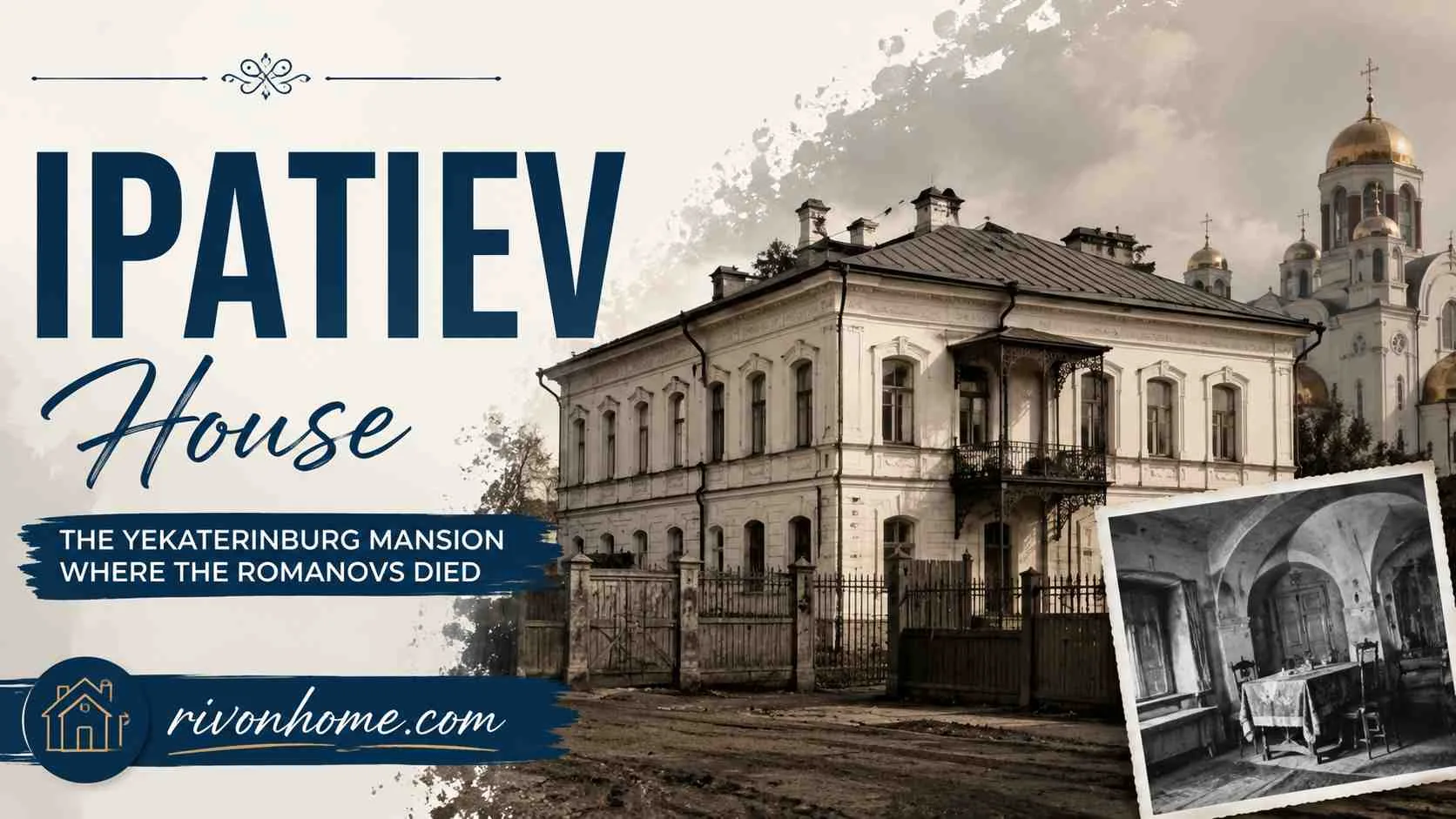
The Ipatiev House was a historic mansion in Yekaterinburg, Russia, featured on RivonHome for its important place in history. Built in the 1880s, the two-story stone house had a 31-meter façade and a distinctive pseudo-Russian design.
It became the final residence of Tsar Nicholas II, his wife, and their five children before their deaths in 1918. Demolished in 1977, the site now marks a deeply significant chapter of Russian history.
Ipatiev House Location
Full Address: Ulitsa Tolmacheva 34, Yekaterinburg, Russia
The house sat in Yekaterinburg, in Russia’s Ural region — a city renamed Sverdlovsk from 1924 to 1991. It stood at the corner of what are now Karl Liebknecht and Clara Zetkin Streets, formerly Voznesensky Prospekt . The exact coordinates of the site are 56°50’40″N, 60°36’32″E.
Visiting the Ipatiev House Site
As Stefano Schiavon from RivonHome, I arrived expecting to find little more than an empty site, but instead discovered a quiet, well-kept church with a golden dome.
A wooden shrine and stone cross mark the approximate historic location, while visitors come to reflect, light candles, or simply stand in silence. The atmosphere felt less like sightseeing and more like a place of remembrance and reflection.
Inside the Original Ipatiev House
The house itself no longer exists, so this section pulls from letters, photographs, and historical accounts of what it looked like while the Romanovs lived there.
The Merchant’s Mansion
Mining official Ivan Redikortsev commissioned the house in the 1880s, on a slope overlooking the city. It later passed to a gold dealer named Sharaviev, then in 1908 to military engineer Nikolai Ipatiev, who ran his office from the ground floor . Grand Duchess Maria Romanov described it in a letter as small but clean, built on a slope so it showed two floors from the garden side — an extra source I found while researching this piece.

The Family’s Rooms
When the Romanovs arrived on 30 April 1918, they were given four rooms on the upper floor, while the guards took the ground level . Maria’s letters describe a household short on basics — no camp beds, no linens, dust everywhere until they found a broom . One bathroom served the entire upper floor. The windows were painted over, cutting off any view outside.

The Basement Room
The family spent 78 days confined here before being led down to a small semi-basement room in the early hours of 17 July 1918 (. Chairs were brought in for the Tsarevich and Tsarina. Yakov Yurovsky and his squad shot the family and their four remaining staff there; the killing took between twenty and thirty minutes.

Guards and Security
A high wooden fence sealed the property off from the street, and the family was allowed only brief, supervised exercise in an enclosed garden (Wikipedia). Command of the guard passed to Yurovsky, a senior Ural Soviet official, in early July 1918. The house had already been nicknamed the “House of Special Purpose” by the Bolsheviks who requisitioned it.

A Surviving Chandelier
One detail I hadn’t expected: a bronze chandelier from the house survived and now sits in a museum collection, last displayed at London’s Science Museum in 2018. It hung above the room where the Grand Duchesses dressed on their final night — another extra find beyond the original source list.

What Happened to the House?
Soviet authorities turned it into a revolution museum branch in 1927, then an agricultural school, then an anti-religious museum by 1938. Party officials once posed for photos by the bullet-marked basement wall. As it quietly became a pilgrimage site, the Politburo ordered it demolished ahead of the revolution’s 60th anniversary. Boris Yeltsin, then local party chief, carried out the demolition in September 1977.

What Stands There Now
After the Soviet Union dissolved, the Church on the Blood — one of Russia’s largest churches — was built on the site, completed in 2003 . An Orthodox cross beside the church marks where the family died. Before demolition, museum staff saved decorative fragments from the house; they’re on display at the Poklevsky-Kozell House Museum in Yekaterinburg.

Ipatiev House Now: Other Romanov Sites to Know
Ganina Yama The mineshaft outside Yekaterinburg where the bodies were initially disposed of . A monastery now stands there too.
Ipatiev Monastery, Kostroma No relation by ownership, but the name overlaps by coincidence: it’s where the first Romanov tsar was crowned in 1613.

Ipatiev House in The Crown
Season 5’s episode “Ipatiev House” dramatizes the family’s final hours . Production designer Martin Childs has said the real basement was never fully documented, so his team built it from photographs and architectural records, blending a real filming location with a reconstructed set.

Who Were the Romanovs?
Nicholas II was born in 1868 and reigned as Russia’s last tsar from 1894 until his abdication in 1917. He, his wife Alexandra, their four daughters, and son Alexei were held with their doctor and three staff members before the execution. Their deaths ended over 300 years of Romanov rule in Russia.
Conclusion
The Ipatiev House isn’t a mansion you’d tour for its architecture. It’s a site people visit to remember what happened there — a family’s final weeks, and a killing that closed a 300-year dynasty.
Standing at the church built on that ground, you feel the weight of it more than any staircase or chandelier ever could. Some places matter for what they hold, not how they look.
Frequently Asked Questions
Is the Ipatiev House still standing today?
No. It was demolished in September 1977 on Politburo orders. On forums like r/TheCrownNetflix, this is a common point of confusion — viewers often ask whether the show filmed at the real house, and the answer is no, since nothing of the original building remains.
What is in the Ipatiev House basement?
The semi-basement room is where the execution took place. Nothing of it survives on-site; the room is known today only through photographs, forensic accounts, and testimony from the killers.
Is the Ipatiev House haunted?
There’s no verified evidence of this. What people usually mean is the site’s heavy symbolic weight — it’s treated in Russia as sacred ground rather than a haunted location, which is part of why pilgrims kept visiting even after demolition .
Where is the Ipatiev House located?
In Yekaterinburg, Russia, at the former corner of Voznesensky Prospekt, now Karl Liebknecht Street .
Can you see photos of the Ipatiev House?
Yes. Archival photos of the exterior, the fenced courtyard, and the basement wall are held by outlets like Getty Images and Wikimedia Commons.
